Industrial Water Treatment Guide
Follow the treatment process from raw water analysis to pretreatment, reverse osmosis, and optional EDI or polishing.
Industrial pure water is not the product of a single “filtration” step, but a staged barrier system that progressively reduces contaminants according to the raw water conditions and target water quality. Different industries define “purity” very differently: semiconductor wafer cleaning requires resistivity to reach 18.2 MΩ·cm; pharmaceutical water for injection uses conductivity ≤ 1.3 μS/cm as a key indicator; and high-pressure boiler make-up water usually falls within the range of 1–10 MΩ·cm. This difference determines the number of process stages, equipment configuration, and operating boundary conditions.
What is the production process for industrial pure water?
The core logic of the industrial pure water production process is “staged treatment according to demand.” Raw water may contain suspended solids, colloids, organics, residual chlorine, hardness, dissolved salts, carbon dioxide, microorganisms, trace silica, and other impurities, and no single technology can economically treat all of these targets at the same time. Therefore, industrial systems usually combine pretreatment, reverse osmosis (RO), electrodeionization (EDI), or polishing mixed beds into a series of barriers, with each stage set with a removal target for a specific category of contaminants and providing product water that meets the influent requirements of the next stage.
Taking the typical “pretreatment—RO—EDI—polishing treatment” route as an example, the final product water resistivity of the system can be stably maintained at 15–18 MΩ·cm; if a polishing mixed bed is added, the effluent can further approach the theoretical pure water limit of 18.2 MΩ·cm. The engineering significance of this staged structure lies in the following: RO bears the main load of dissolved salt removal, EDI achieves deep desalination without the need for acid-base regeneration, and post-treatment controls “trace but critical” indicators such as TOC, particles, and microorganisms.
Main Stages of Industrial Water Purification
Raw Water Analysis
Raw water analysis determines the “starting point” and “constraint conditions” of the subsequent process. Taking an RO system as an example, the influent typically needs to meet basic thresholds such as pH 3–10, SDI ≤ 5, turbidity ≤ 1.0 NTU, and residual chlorine ≤ 0.1 ppm. These indicators are not isolated requirements: excessive residual chlorine will oxidatively damage polyamide composite membranes, while excessively high SDI or turbidity means that colloids and suspended solids may rapidly form fouling on the membrane surface. If the raw water has high hardness or silica content, dedicated softening or silica removal units also need to be installed in the pretreatment stage; otherwise, the recovery rate of the downstream RO will be constrained, and the EDI module will also face scaling risks.
For EDI, the influent requirements are even more sensitive. EDI modules typically require the conductivity of the upstream RO product water to be controlled below 20 μS/cm, total hardness (as CaCO₃) below 1.0 ppm (recommended < 0.5 ppm), TOC < 0.5 ppm, and residual chlorine must not be detectable. This means that raw water analysis should not only examine the “raw water itself,” but also predict whether, after RO, it can stably meet the EDI influent window.
Water Pretreatment
The goal of pretreatment is to adjust the raw water to influent conditions under which the reverse osmosis membrane can operate stably over the long term. Multi-media filters (typically using quartz sand, anthracite, and other materials as filter media) and activated carbon filters are the most common two-stage pretreatment configuration in industrial pure water systems. The design filtration rate of a multi-media filter is generally 8–12 m/h, and the filter bed height is commonly 800–1200 mm; the operating flow velocity of an activated carbon filter is usually controlled at 6–10 m/h, and it mainly performs residual chlorine removal and adsorption of some organic matter.
In membrane-based systems, pretreatment also includes cartridge filters (typically with a 5 μm rating) as well as necessary dosing of antiscalant and reducing agent. For raw water with high hardness, softeners or alkaline precipitation are also common options. Whether the pretreatment is adequately designed directly determines the cleaning cycle and service life of the RO membrane—once SDI and residual chlorine control in the RO influent fail, the performance degradation of membrane elements is often irreversible.
Reverse osmosis treatment
Reverse osmosis is the main unit for dissolved salt removal in industrial pure water processes. Under pressure drive, water permeates through the semipermeable membrane while dissolved salts, heavy metals, and most organic matter are retained. The salt rejection rate of industrial RO systems is typically between 95% and 99%, and common requirements in actual engineering are salt rejection > 97% or > 98%. System recovery varies depending on raw water quality and process configuration: the recovery rate of single-stage RO is commonly 70%–80%, and after configuring concentrate recirculation or a multi-stage design, it can be increased to 85%–90%.
The operating pressure depends on the membrane type and the salt content of the influent. The operating pressure of ultra-low-pressure membrane elements can be as low as 0.4–0.8 MPa, while high-pressure reverse osmosis may reach the range of 2–7 MPa in specific wastewater reuse scenarios. RO product water quality is usually characterized by conductivity or TDS. For systems with downstream EDI, the conductivity of RO product water needs to be stably maintained within the EDI-permissible influent window, which is also the reason why many industrial systems use two-stage RO as pretreatment for EDI.
Optional EDI and post-treatment
EDI combines ion exchange resin with electrodialysis to achieve directional migration of ions under a direct current electric field, while utilizing water dissociation to regenerate the resin in situ, thereby continuously producing high-purity water without the need for acid-base chemical regeneration. The typical product water resistivity of industrial EDI is 15–18 MΩ·cm, and the product water recovery rate can reach about 95%. For pharmaceutical water for injection, EDI product water needs to be further controlled with conductivity ≤ 1.3 μS/cm (25 °C) as the control indicator; for electronic semiconductor packaging, typically more than 15 MΩ·cm is required.
When the target water quality approaches 18.2 MΩ·cm, the post-treatment stage usually needs to incorporate a polishing mixed bed. The polishing mixed bed uses non-regenerable high-purity mixed resin, connected in series after EDI or two-stage RO, and the effluent resistivity can reach 18.2 MΩ·cm. At the same time, it has control capability for TOC and SiO₂, and TOC can be controlled below 10 ppb. If there are stricter requirements for TOC, a 185 nm ultraviolet oxidation unit can further reduce TOC to 1 ppb or even sub-ppb levels. Terminal ultrafiltration or precision filtration (0.2 μm or 0.5 μm) is used to control particulate matter, and ultraviolet sterilization (254 nm) is used for microbial control.
Industrial Water Purification Equipment
The equipment configuration of an industrial pure water system is organized around the staged treatment logic described above.
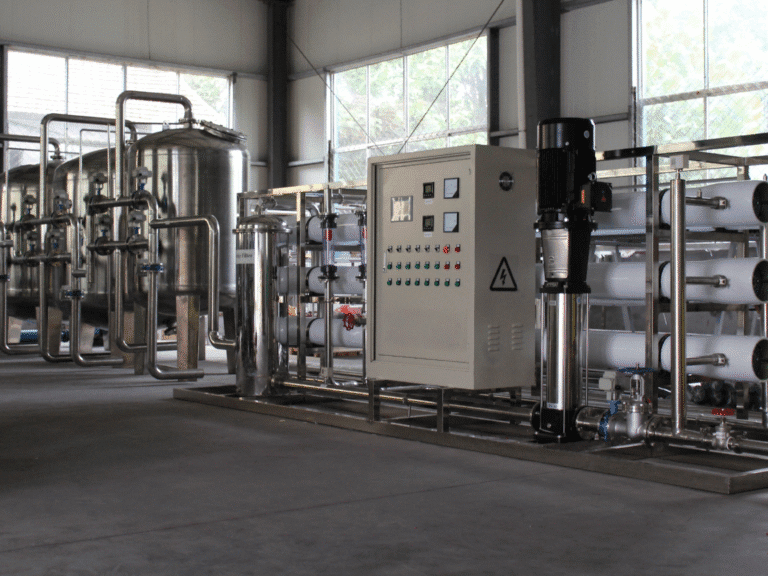
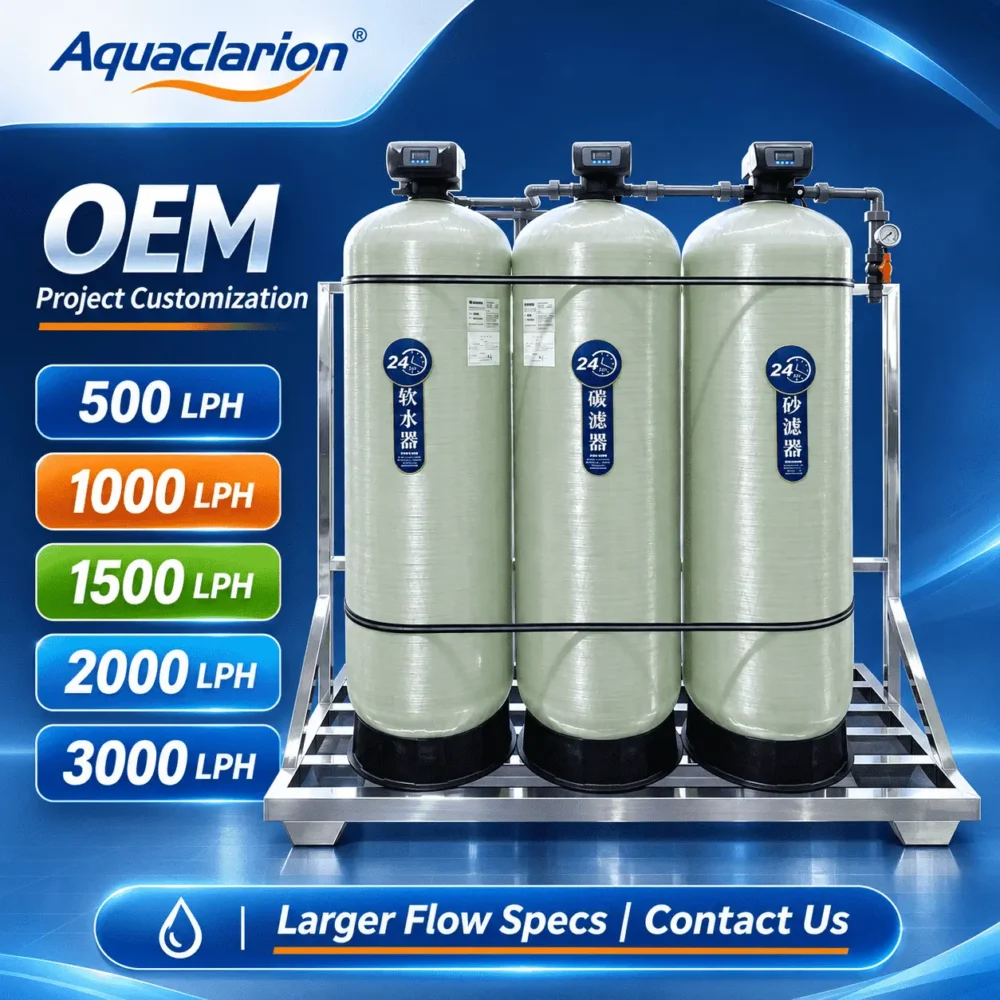
Pretreatment equipment mainly includes multi-media filters, activated carbon filters, softeners, cartridge filters, and dosing systems. The selection of multi-media filters and activated carbon filters is determined based on treated water flow rate, raw water turbidity, and organic load, with filtration rate and filter bed height being the core design parameters.
The reverse osmosis (RO) unit consists of a high-pressure pump, RO membrane modules, pressure vessels, inter-stage piping, flow and pressure monitoring instruments, and a chemical cleaning system. The number and arrangement of the RO membrane elements—such as a single-stage or two-stage configuration—are determined based on target recovery rates and the desired concentration factor for the reject stream. Online conductivity sensors and pressure transmitters are used to monitor the salt rejection rate and the pressure differential across the membranes; if the permeate quality declines or the pressure differential exceeds a set threshold, an off-line chemical cleaning process is required.
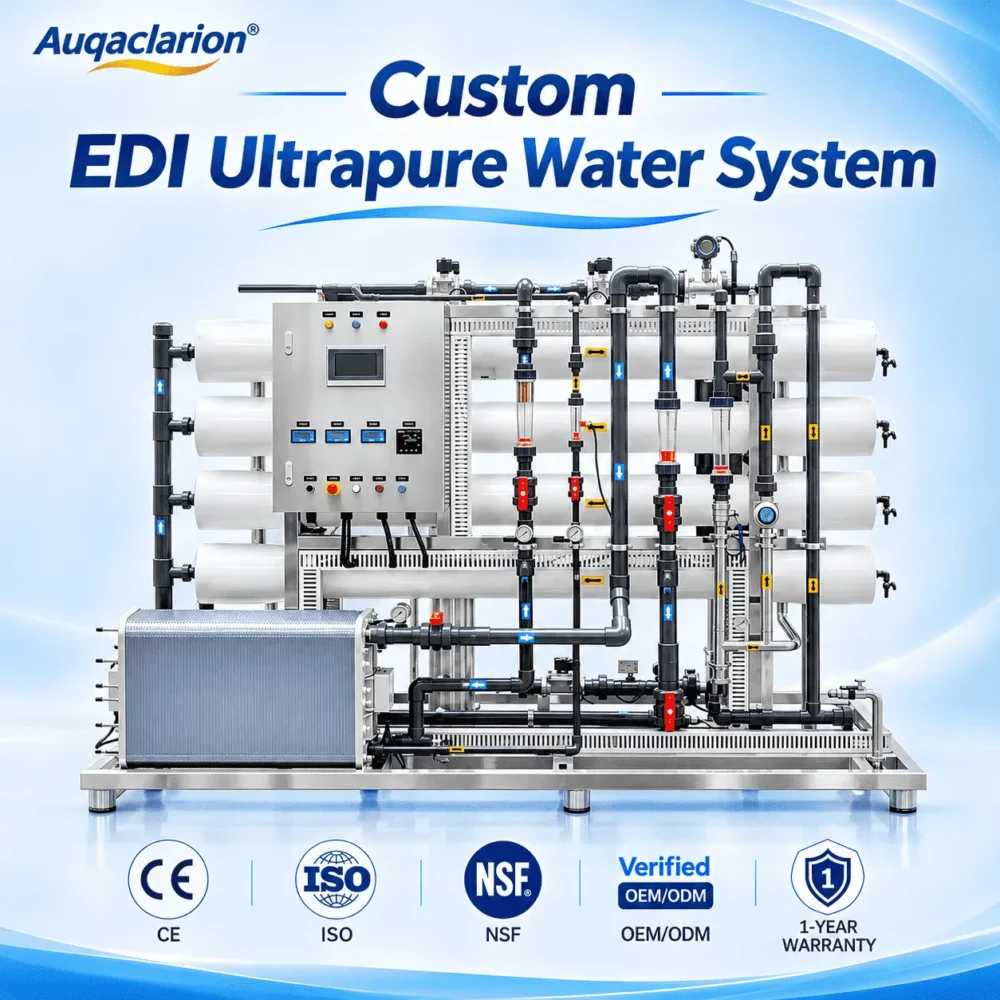
EDI modules usually operate in parallel in a modular form, with the product water capacity of a single module generally in the range of 0.5–8 m³/h. Engineering design often adopts an N+1 redundant configuration, i.e., one additional standby module is installed to avoid system shutdown caused by cleaning or failure of a single module. The power supply configuration for EDI is recommended to use a “one-to-one” mode to facilitate independent control and maintenance.
Post-treatment equipment includes polishing mixed beds, UV oxidation/sterilization devices, terminal precision filters, and pure water storage tanks (often equipped with nitrogen blanketing to prevent carbon dioxide from dissolving in). The selection of these units depends on the terminal water quality standards: electronic-grade ultrapure water has the strictest requirements for TOC and particles, while pharmaceutical water also needs to take microbial and endotoxin control into account.
How to Select a Pure Water Process?
The first principle of process selection is to “work backward from the terminal water quality to determine the number of stages,” rather than blindly pursuing the highest configuration.
Wafer manufacturing usually requires ≥ 18.2 MΩ·cm, with strict control of TOC, particles, and dissolved oxygen. The process route generally includes two-stage RO + EDI + polishing mixed bed + UV oxidation + terminal ultrafiltration.
The requirements for electronic semiconductor packaging are relatively less stringent; above 15 MΩ·cm can meet most scenarios, and depending on raw water conditions, the polishing mixed bed may be omitted or single-stage EDI may be used.
Pharmaceutical water for injection does not use resistivity as the sole indicator; conductivity ≤ 1.3 μS/cm (25 °C) is a key control point under the pharmacopoeial framework, and attention also needs to be paid to microorganisms and endotoxins, so UV and ultrafiltration have higher priority in the post-treatment configuration.
Chemical production usually requires ≥ 10 MΩ·cm, and the process can use EDI or a mixed bed as the endpoint for deep desalination.
The water quality requirements for power boiler make-up water vary depending on the boiler pressure level; medium- and high-pressure boilers usually require make-up water in the 1–10 MΩ·cm range, and RO + EDI or RO + mixed bed are common routes.
Common Industrial Applications
The largest industrial consumption areas for high-purity water are concentrated in three major industries: power, pharmaceuticals, and microelectronics.
In the power industry, if high-pressure boiler make-up water is insufficiently pure, dissolved salts will deposit on boiler and turbine blades, leading to reduced heat transfer efficiency and increased corrosion risk. RO + EDI or RO + mixed bed systems can provide make-up water in the 1–10 MΩ·cm range, meeting the water quality requirements of medium- and high-pressure boilers.
In the pharmaceutical industry, purified water (PW) and water for injection (WFI) need to comply with the relevant requirements of USP, EP, or ChP. Conductivity is the core online indicator for pharmacopoeial purified water, and water for injection also requires control of bacterial endotoxins. Because EDI requires no acid-base regeneration and can operate continuously, it is widely used as the deep desalination unit after RO in pharmaceutical pure water systems.
In the electronics and semiconductor industry, wafer cleaning and photolithography processes have the most stringent requirements for ultrapure water. Resistivity ≥ 18.2 MΩ·cm is the basic threshold, and TOC, particles, and metal ions all need to be controlled at the ppb or ppt level. Such systems usually require a combination of two-stage RO, EDI, polishing mixed bed, 185 nm UV, and terminal ultrafiltration; fluctuations in any single unit may affect wafer yield.
In addition, industrial pure water is also widely used in fields such as food and beverage, chemicals, metallurgy, and laboratory analysis, but the water quality grade and process complexity decrease progressively with the application scenario. Understanding the logic that “the end use determines the water quality, and the water quality determines the process” is more critical than memorizing a fixed process flow.
Frequently Asked Questions (FAQ)
Does an industrial pure water system necessarily need to be equipped with EDI?
Not necessarily. The core value of EDI lies in achieving deep desalination in a continuous manner without chemical regeneration, making it suitable for scenarios with higher requirements for operational continuity, wastewater discharge, and operator workload. If the terminal water quality only needs to reach 1–5 MΩ·cm, or if the raw water salt content is low, configuring a mixed bed after RO or relying solely on RO may also meet the requirements. The decision on whether to use EDI should be based on a comprehensive judgment of water quality targets, raw water salt content, acid-base management costs, and total life-cycle costs.
Does an RO salt rejection rate of 98% mean the product water can be used directly?
Not necessarily. A 98% salt rejection rate refers to the proportional removal relative to the influent salt content; the absolute salt content of the product water still depends on the raw water TDS. If the raw water TDS is high, even with a 98% salt rejection rate, the product water conductivity may still exceed the allowable range for EDI or the terminal process. Therefore, whether RO product water is “qualified” needs to be judged by the absolute indicators of the target water quality (such as conductivity and resistivity), rather than by salt rejection rate alone.
How significant is the gap between EDI product water resistivity of 15 MΩ·cm and 18.2 MΩ·cm?
Numerically, the gap is not large, but in electronic-grade applications, this gap corresponds to trace ion and TOC levels that may directly affect process outcomes. 15 MΩ·cm can usually meet the requirements of semiconductor packaging and general industrial high-purity water; 18.2 MΩ·cm is aimed at scenarios such as wafer cleaning that are extremely sensitive to trace contaminants, and typically requires a polishing mixed bed or more stringent post-treatment as a safeguard. Selection should be based on the formal water quality specifications of the terminal process to avoid “over-treatment” or “under-treatment.”
Recommended Products

Custom FRP Multi-media Filtration System
Original price was: $899.00.$699.00Current price is: $699.00.Custom Large-Scale Industrial FRP RO Systems
Original price was: $3,299.00.$2,999.00Current price is: $2,999.00.Customized Large-Capacity Industrial RO EDI Ultrapure Water System
Original price was: $15,899.00.$14,899.00Current price is: $14,899.00.Commercial 0.25-0.5 T/H Tap Water Treatment Machinery With Tank
Original price was: $799.00.$699.00Current price is: $699.00.

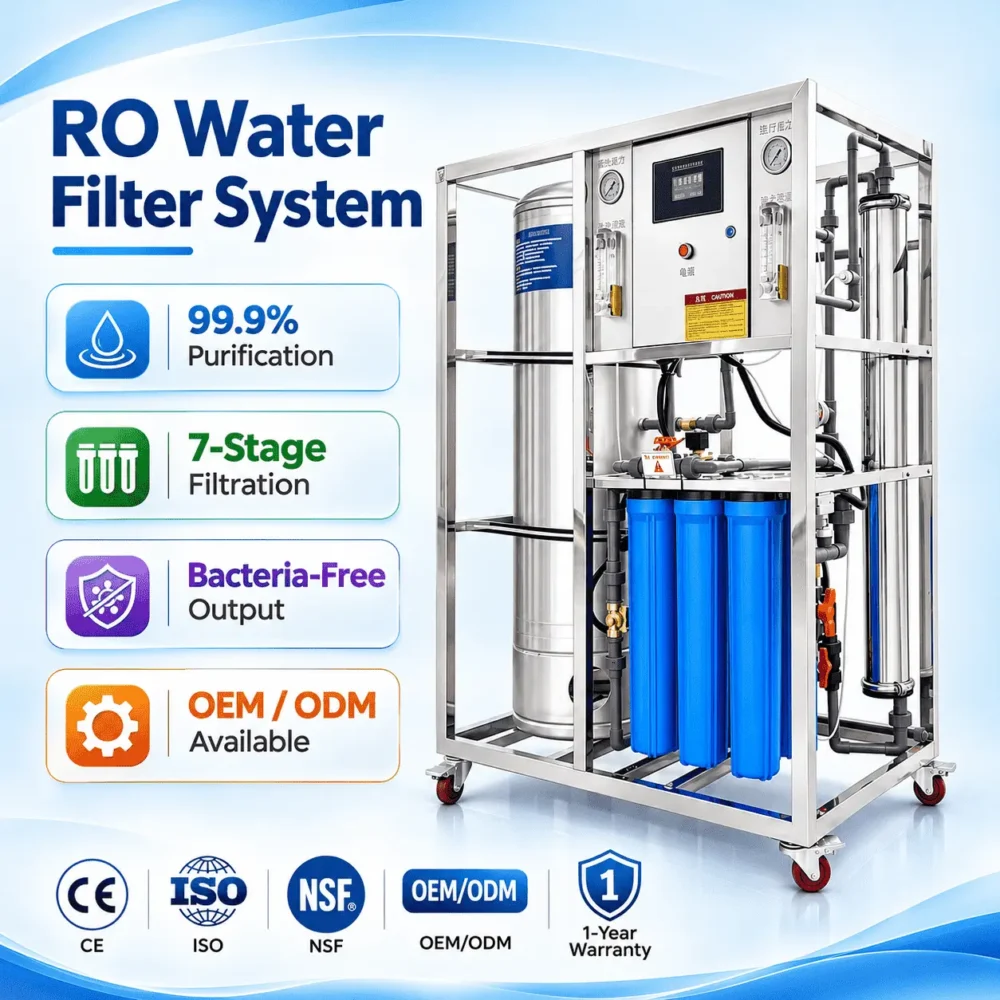
Need Help Selecting an Industrial Pure Water System?
Share your feed water quality, required flow rate, and target water quality with AquaClarion. We can help you evaluate pretreatment, reverse osmosis, and EDI or polishing options for your application.
Discuss Your Water Treatment Project