
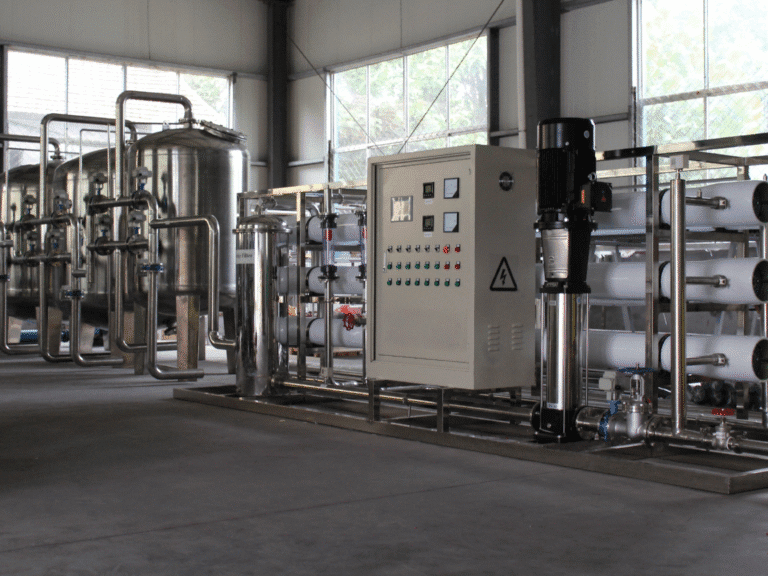
RO Membrane Technical Guide
Calculate the cleaning solution you need—first with a quick estimate, then with vessel, piping, filter and safety-margin data.
AquaClarion Water TreatmentRO CleaningVolume Guide| Planning method | Best use |
|---|---|
| Quick estimate | When site measurements are unavailable |
| Precise calculation | When vessel, piping and filter capacities are known |
| Final preparation | Add the 20% safety margin and verify tank level |
When performing chemical cleaning on a Reverse Osmosis (RO) membrane system, one of the most frustrating questions for field operators is: “How many liters of cleaning solution should I prepare in the tank?” If you prepare too little, the cleaning pump may draw air and damage the equipment; if you prepare too much, you end up wasting chemicals and pure water.
In practice, the total required volume of cleaning solution consists of four parts: Pressure Vessel Volume + Cleaning Piping Volume + Cartridge Filter Volume + 20% Safety Margin (to prevent the tank level from dropping too low during circulation).
This guide provides both a Rough Estimation Method and a Precise Calculation Method to help you quickly figure out the exact volume needed on-site.
1. Quick Rough Estimation Method (For Emergency On-Site Preparation)
If site conditions are limited and there is no time to measure piping lengths in detail, you can roughly estimate the volume based on the membrane element model and the severity of fouling:
A. Normal / Light Fouling (Routine Maintenance Cleaning)
- 4040 Membrane Element (4-inch small membrane): Prepare 10 liters per element.
- 8040 Membrane Element (8-inch large membrane): Prepare 40 liters per element.
B. Severe Fouling (Heavy Scaling or Long-Overdue Cleaning)
- 4040 Membrane Element (4-inch small membrane): Prepare 18 liters per element.
- 8040 Membrane Element (8-inch large membrane): Prepare 55 liters per element.
2. Precise Calculation Method (Step-by-Step Formula & Reference Tables)
To ensure effective cleaning without wasting chemicals, using the precise calculation method is recommended. Before calculating, check the two baseline capacity reference tables below:
A. Baseline Parameter Reference Tables
Table 1: Volume Capacity Rate of Common Cleaning Piping
| Pipe Diameter (in / Inches) | Volume Rate (Gal/ft) | Volume Rate (Liters/Meter) |
| 2 | 0.16 | 2.0 |
| 3 | 0.37 | 4.6 |
| 4 | 0.65 | 8.1 |
Table 2: Volume Capacity of Pressure Vessels (Per Membrane Element Space)
| Membrane Element Size | Volume Per Element Gallons (Liters) |
| 2540 | 0.8 (3) |
| 4040 | 2 (8) |
| 8040 | 8 (32) |
B. Step-by-Step Calculation Example
【Project Background】: A system contains 36 8040-type membrane elements arranged in a 4:2 array (4 pressure vessels in the 1st stage and 2 pressure vessels in the 2nd stage), with 6 8040 elements per vessel. The system is cleaned stage-by-stage. The 3-inch nominal diameter cleaning pipe is 15 meters long, and the cartridge filter holds 60 liters of water.
Based on these parameters, the calculations for each stage are as follows:
🔹 1st-Stage Cleaning Volume Calculation
- Pressure Vessels Volume: 4 vessels × 6 elements × 32 L/element = 768 L
- Cleaning Piping Volume: 15 meters × 4.6 L/m = 69 L
- Cartridge Filter Volume: 60 L
- Base Subtotal (Without Safety Margin): 768 + 69 + 60 = 897 L
- Plus 20% Safety Margin: 897 L × 20% = 180 L (Margin) 👉 Total Required Volume for 1st Stage: 897 + 180 = 1,077 Liters
🔹 2nd-Stage Cleaning Volume Calculation
- Pressure Vessels Volume: 2 vessels × 6 elements × 32 L/element = 384 L
- Cleaning Piping Volume: 15 meters × 4.6 L/m = 69 L
- Cartridge Filter Volume: 60 L
- Base Subtotal (Without Safety Margin): 384 + 69 + 60 = 513 L
- Plus 20% Safety Margin: 513 L × 20% ≈ 102 L (Margin) 👉 Total Required Volume for 2nd Stage: 513 + 102 = 615 Liters
📊 Summary Table
| Component / Item | 1st-Stage Volume (Liters) | 2nd-Stage Volume (Liters) |
| Pressure Vessels | 4 × 6 × 32 = 768 | 2 × 6 × 32 = 384 |
| Cleaning Piping | 15 × 4.6 = 69 | 15 × 4.6 = 69 |
| Cartridge Filter | 60 | 60 |
| 20% Safety Margin | 180 | 102 |
| Total Cleaning Solution Volume | 1,077 Liters | 615 Liters |
💡 On-Site Cleaning Safety Tips
- Protect Against Corrosive Chemicals: Operators must wear protective face shields, acid/alkali-resistant rubber gloves, and aprons during chemical preparation and circulation.
- Exercise Caution with Special Chemicals: When removing severe silica deposits or other specialized scaling, fluorine-containing agents may be required. These chemicals are highly corrosive and hazardous; it is strongly recommended to conduct the cleaning under professional technical supervision.
- Reference Notice: The calculation examples above are based on standardized formulas. Adjustments should be made on-site based on actual piping layouts and vessel capacities.
Frequently Asked Questions (FAQ)
Q1: Why is it necessary to add a 20% safety margin?
Answer: During circulation, cleaning fluid flows through the pipes and vessels, and some liquid remains trapped in dead spots. Additionally, starting the pump instantly draws down the level in the cleaning tank. Without the 20% safety margin, the tank could easily run dry, causing pump cavitation or introducing large air bubbles into the membrane elements.
Q2: Can I reuse the cleaning solution from the 1st stage for the 2nd stage?
Answer: It is not recommended. The types of foulants in the 1st and 2nd stages are often different (the 1st stage usually suffers from colloidal/organic fouling, while the 2nd stage is prone to mineral scaling). Furthermore, the solution after the 1st-stage cleaning contains high amounts of detached debris and foulants, which can cause secondary contamination if pumped into the 2nd stage.
Need Help Sizing an RO Cleaning Batch?
Share your membrane model, vessel count, piping dimensions and filter capacity with AquaClarion to discuss the required cleaning volume.
Discuss Your RO System →