
RO-EDI Ultrapure Water Treatment System
An industrial RO EDI ultrapure water system combines reverse osmosis and electrodeionization to deliver stable, low-conductivity water for laboratory and industrial processes.
Years of Experience
Countries Served
Customer Satisfaction
Industrial RO Systems
Prepare suitable permeate for EDI →
RO + EDI Packages
Integrated high-purity water systems →
Double-Pass RO Options
Additional RO polishing when required →
Monitoring & Post-Treatment
Conductivity, UV, storage & polishing →
Why RO + EDI
RO removes the bulk dissolved load. EDI provides continuous deionization polishing
The EDI stage should not be treated as a raw-water filter. Its performance depends on suitable upstream purification and stable feed-water quality from the RO section.
01 · PREPARE
RO Creates Suitable EDI Feed
Pretreatment and RO reduce the bulk dissolved and particulate load before the water reaches the EDI module.
02 · POLISH
EDI Continuously Removes Ions
EDI is used as a downstream polishing stage to further reduce ionic contamination without the same regeneration cycle used by conventional mixed-bed polishing.
03 · VERIFY
Monitor Final Water Quality
Conductivity or resistivity monitoring should be arranged according to the final application and required quality specification.
01 · SYSTEM DESIGN BASIS
Start with where the water enters the RO + EDI treatment train
Select the starting water condition, capacity, final-water requirement and application. The treatment path will update automatically.
02 · RO + EDI PROCESS
Recommended process path
Core, typical and optional stages update from the selected design basis.
Current RO + EDI Process
Automatically generated from the treatment stages selected above.
Typical logic: Pretreatment → Cartridge Filtration → RO → RO Permeate Tank → Optional Second-Pass RO → EDI Feed Quality Check → EDI → Optional UV / Polishing → High-Purity Water Storage / Distribution.
Typical RO + EDI treatment path
This fixed overview describes a common design sequence; it is not the live result of the selector above.
- Prepare the feed water. Select filtration, dechlorination, softening or dosing from the water analysis, then protect the RO stage with cartridge filtration. Existing pretreated feed may require fewer upstream stages.
- Produce suitable RO permeate. Design the RO stage around the selected EDI module’s feed-water limits. Add a second RO pass only when permeate quality or the final target requires it.
- Polish with EDI. Check the RO permeate, control feed flow and pressure, then use the EDI module for continuous ionic removal.
- Condition and distribute the final water. Add UV, final polishing, storage or a distribution loop only as the application requires; monitor conductivity or resistivity at the specified points.
The final stages and water-quality target must be confirmed from the water analysis, application requirements and engineering design.
What Determines EDI Performance
The EDI module is only one part of the high-purity water system
RO Permeate Quality
The EDI section should receive suitable RO permeate. Poor or unstable upstream quality can reduce system performance.
Target Conductivity / Resistivity
The final polishing design and monitoring points should match the actual water-quality target rather than a generic “ultrapure” label.
Required Flow & Operating Hours
Capacity, operating profile and standby conditions affect module selection, tanks, pumps and control strategy.
Application & Distribution
Laboratory, electronics, pharmaceutical, boiler and process-water projects may require different post-treatment, storage and distribution arrangements.
03 · RO + EDI TECHNOLOGY MAP
Explore the main technologies in a complete high-purity water train
Click a technology to view its function and common position in the RO + EDI system.
Applications
Where RO + EDI high-purity water systems are commonly considered
The actual final-water standard should always be confirmed from the project specification and local / industry requirements.
01 · LAB
Laboratory & Analytical
High-purity feed water for analytical, testing or laboratory processes where low ionic contamination is required.
02 · ELECTRONICS
Electronics & Precision
Process-water preparation for manufacturing steps that require tighter ionic control and stable water quality.
03 · PHARMA
Pharmaceutical / Medical Process
High-purity process-water projects where the full treatment and sanitation design must be matched to the applicable specification.
04 · BOILER
Boiler / Power / Steam
Polishing applications where lower conductivity and reduced ionic loading are required before downstream steam or power processes.
04 · PROJECT INQUIRY
Turn your high-purity water target into a structured RO + EDI inquiry
Free Engineering Consultation
Our water treatment experts are ready to support your project from design to commissioning.
- System configuration & process design
- Equipment selection & technical proposal
- Drawings, datasheets and documentation
- Global shipping and on-site support
Typical Response Time
Within 24 hours
(working days)
Technical questions?
jack@aquaclarion.com
05 · FAQ
Frequently Asked Questions
Why do we need RO before EDI?
EDI is designed to polish suitably treated water, typically RO permeate, rather than raw water. RO reduces the dissolved salt load before the EDI stage. EDI then continuously removes remaining ions using electrically regenerated ion-exchange resin. If the RO permeate is outside the selected EDI module’s feed-water limits, scaling, fouling, unstable product-water quality or premature module failure may result. The pretreatment and RO design must therefore be confirmed from the water analysis and the chosen module’s specifications.
What feed water should the EDI module receive?
The EDI module should receive RO permeate that meets the selected module manufacturer’s feed-water specifications. Before final selection, we review relevant measurements such as conductivity, hardness, silica, TOC, dissolved CO₂, oxidants and turbidity. The allowable limits depend on the module and the required product-water quality; a single set of limits should not be applied to every project. For an existing RO system, please provide a recent permeate analysis.
What is the difference between RO and EDI?
RO is the main membrane separation stage used to remove a large proportion of dissolved salts and other contaminants. EDI is a downstream polishing stage used to further reduce ionic contamination in already purified RO permeate.
Do I need double-pass RO before EDI?
Not every project requires double-pass RO. It should be considered when the upstream water quality, EDI feed requirement or final water target justifies an additional RO polishing stage.
What is the typical lifespan of EDI modules in an industrial system?
Under proper operation, maintenance, and adherence to strict feed water specifications (e.g., hardness < 0.1 ppm, silica < 1 ppm, TOC < 0.5 ppm), high-quality industrial EDI modules typically last between 5 to 10 years (with an average of around 7 years). Lifespan is primarily determined by feed water quality, pre-treatment reliability, and adherence to recommended cleaning and flushing protocols.
Can UV, storage and a distribution loop be integrated after EDI?
Yes. UV, storage, final polishing and distribution arrangements can be added when required by the application and final water-quality specification.
Explore Systems by Capacity
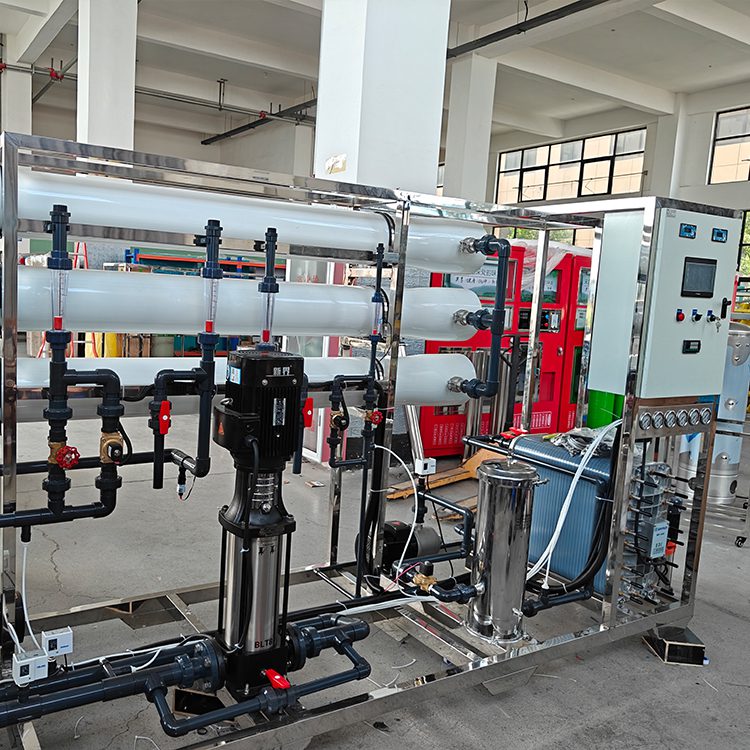
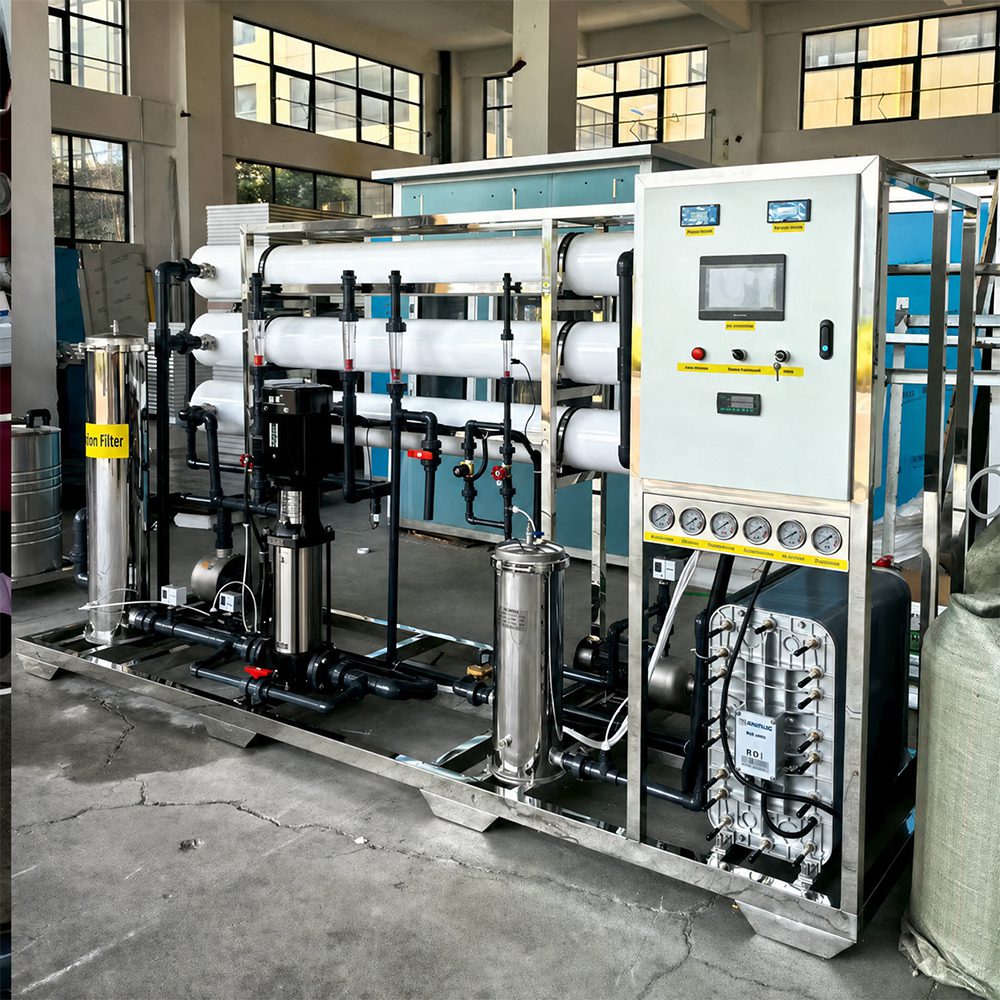
These published capacity series are reference examples, not a quotation or a final equipment list calculated from the selector above. Pretreatment, membrane arrangement and performance are confirmed after reviewing feed-water analysis and project requirements.

APPLICATION INQUIRY
Get an RO + EDI High-Purity Water Recommendation
Starting water · RO permeate quality · Capacity · Application · Target conductivity / resistivity
Global Service
Reliable Quality
Long-term Partner