Water Pretreatment & Softening Systems
Water pretreatment and softening systems are designed to reduce sediment, turbidity, iron, manganese, chlorine, hardness and scale risk before reverse osmosis or final use.
Years of Experience
Countries Served
Customer Satisfaction
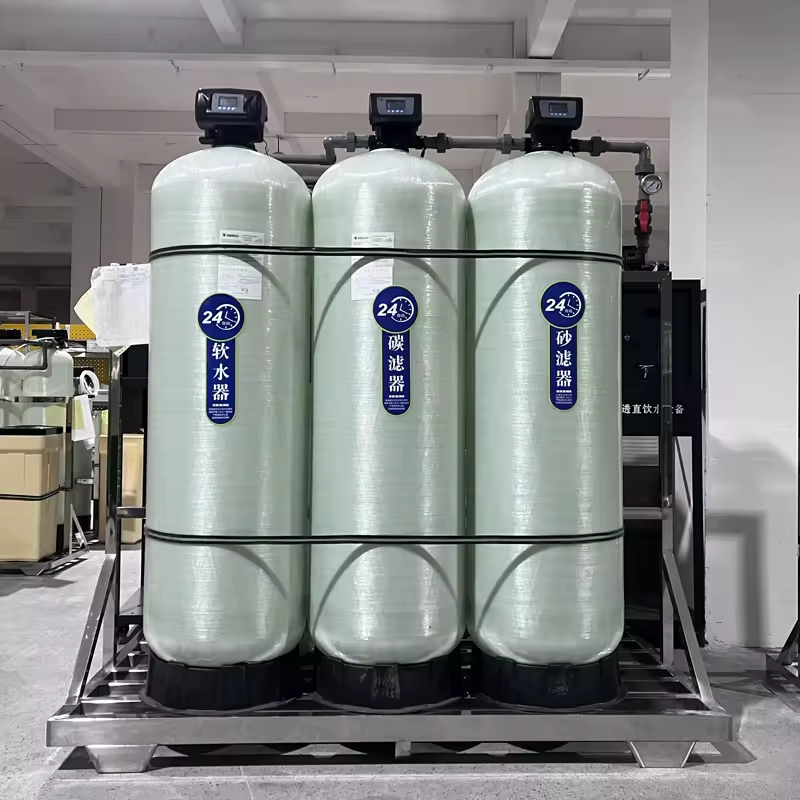
Multimedia Filtration
Suspended solids & turbidity control →
Activated Carbon Filtration
Chlorine, odor & adsorption treatment →
Water Softening Systems
Hardness & scale control →
Cartridge Filtration
Filter micron-sized particles →
Why Pretreatment Matters
Different water problems need different pretreatment
Pretreatment is not one fixed tank sequence. The media, softening and chemical-control stages should be selected from the actual feed-water conditions and downstream risk.
01 · CLARIFY
Reduce Particle Loading
Control sediment, suspended solids and turbidity before finer filtration, membranes and pumps.
02 · ADSORB
Control Chlorine & Odor
Activated carbon can be used when residual chlorine, odor, color or selected organic loading must be reduced.
03 · SOFTEN
Reduce Hardness Risk
Ion-exchange softening removes calcium and magnesium hardness when scale control is required.
01 · WATER CHALLENGE
Start with the feed-water problem—not a fixed filter package.
Choose the water source, visible water condition, required capacity and application. The page then updates the project note and treatment process.
02 · PRETREATMENT PROCESS
Recommended process path
Suggested pretreatment stages update from the selected water source, water problem and downstream use. You can add or remove optional stages; final selection requires water analysis and engineering review.
- 09Downstream EquipmentRO / boiler / cooling / process / standalone treated-water outlet.OUTPUT
Current Pretreatment Process
Automatically generated from the selected treatment stages.
Typical order: Feed Water → Raw Water Pump → Screening / Pre-Filter → Multimedia / Manganese Sand → Activated Carbon → Water Softener / Antiscalant → Cartridge Filtration → Downstream Equipment.
Typical Water Problems
What each pretreatment stage is designed to solve
An in-depth look at common water issues and pre-treatment solutions.
Turbidity & Sediment
Usually addressed with screening, multimedia filtration and finer particulate protection where required.
Iron & Manganese
May require oxidation conditions and manganese-media filtration depending on the water analysis.
Chlorine & Odor
Activated carbon is commonly used for residual chlorine, odor, color and selected organics.
Hardness & Scale
Ion-exchange softening or other scale-control strategies are selected according to hardness and downstream equipment.
03 · PRETREATMENT TECHNOLOGY MAP
Explore key pretreatment & softening technologies
Click a module to view a simple equipment preview, function and common system position.
04 · RELEVANT PROJECT / APPLICATION INQUIRY
Turn a real project into a structured inquiry
Free Engineering Consultation
Our water treatment experts are ready to support your project from design to commissioning.
- System configuration & process design
- Equipment selection & technical proposal
- Drawings, datasheets and documentation
- Global shipping and on-site support
Typical Response Time
Within 24 hours
(working days)
Technical questions?
jack@aquaclarion.com
05 · FAQ
Frequently Asked Questions
Is a water softener required before every RO system?
No. Softening is selected when hardness and scale risk justify it. The correct choice depends on feed-water hardness, recovery target, membrane design and any alternative scale-control strategy.
What is the difference between a multimedia filter and a water softener?
A multimedia filter mainly reduces suspended solids and turbidity. A softener uses ion-exchange resin to remove calcium and magnesium hardness. They solve different water-quality problems.
Can activated carbon and a softener be used in the same pretreatment line?
Please share your country, application, water source, required capacity or daily demand, and target water quality. A recent water analysis is recommended, but you can submit an inquiry first if TDS or other test results are not yet available.
What is the maximum hardness limit for a standard ion-exchange water softener?
For standard industrial strong acid cation exchange softeners, the maximum recommended feed water hardness is typically 10 to 15 mmol/L (approx. 500 to 750 mg/L as CaCO3). While some heavy-duty systems can handle higher levels (up to 20 mmol/L), feed water exceeding this limit drastically reduces the exchange capacity between regenerations, leading to excessively frequent regeneration cycles, high salt and water waste, and potential resin fouling.
When should we choose duplex (dual-tank) alternating softeners instead of single-tank systems?
- Continuous 24/7 Operations: When your industrial process requires an uninterrupted supply of soft water without shutdowns for regeneration.
- High Flow Rates & Large Water Consumption: When water demand is too high for a single tank to sustain between regenerations.
- Strict Downstream Protection: If downstream equipment (such as RO membranes or boilers) cannot tolerate hard water breakthrough during regeneration cycles. Duplex systems ensure one tank is always online while the other is regenerating or on standby.
Explore Systems by Capacity
These published capacity series are reference examples, not a quotation or a final equipment list calculated from the selector above. Pretreatment, membrane arrangement and performance are confirmed after reviewing feed-water analysis and project requirements.


APPLICATION INQUIRY
Get a Pretreatment & Softening Recommendation
Water source · Main problem · Capacity · Water analysis · Downstream use
Global Service
Reliable Quality
Long-term Partner