
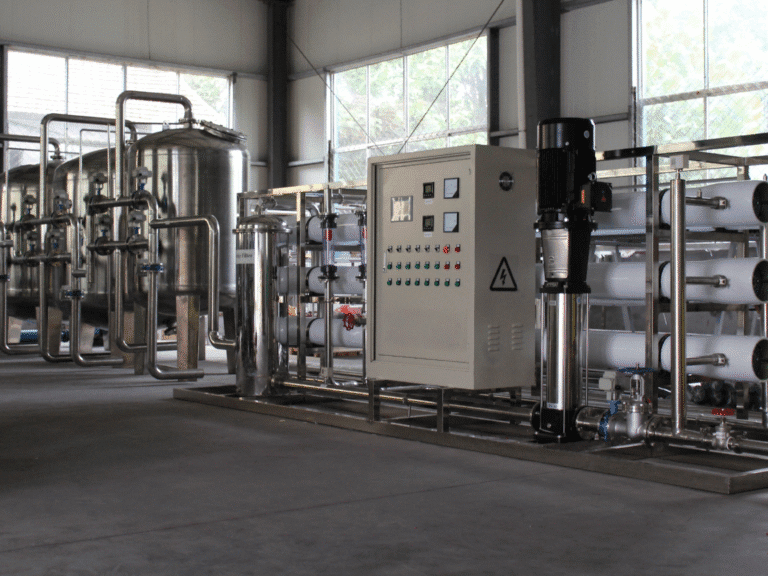
Industrial RO Material Selection Guide
FRP or Stainless Steel? Choose by Function, Not Appearance
A practical engineering guide to selecting FRP, UPVC, SS304, and SS316 for each part of an industrial reverse osmosis system—based on water quality, pressure, hygiene, corrosion risk, and lifecycle cost.
| System area | Common choice | Main reason |
|---|---|---|
| Pretreatment vessels | FRP | Corrosion resistance, low weight, and economy |
| Low-pressure piping | UPVC | Cost-effective corrosion resistance |
| High-pressure section | SS304 / SS316 as required | Mechanical strength and pressure handling |
| Sanitary applications | Higher stainless-steel proportion | Cleanability, finish, and validation |
| High-chloride water | Project-specific hybrid | Avoid unsuitable “all SS304” designs |
“Do you want FRP or stainless steel?”
At first glance, it seems like a simple material choice. FRP is cheaper. Stainless steel looks more premium. So if you’ve got the budget, go stainless. If you’re watching costs, pick FRP.
It’s not that simple.
In real industrial RO projects, choosing between FRP and stainless steel comes down to:
Feed water quality (especially chloride content)
Operating pressure
Industry application
Sanitary requirements
Installation environment
Equipment size
Maintenance approach
Project budget
Expected service life
And there’s one critical point that often gets overlooked:
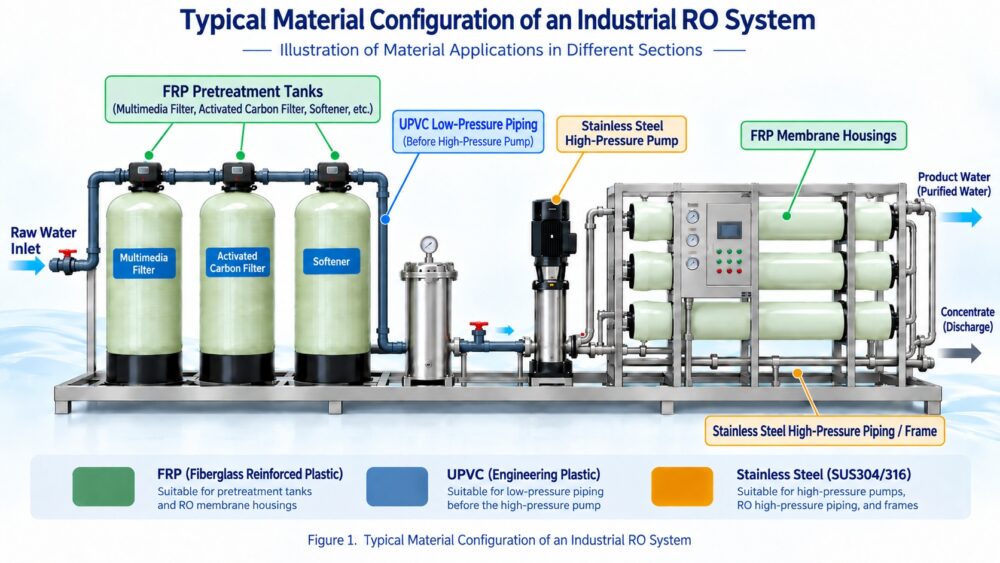
An industrial RO system doesn’t have to be 100% FRP or 100% stainless steel.
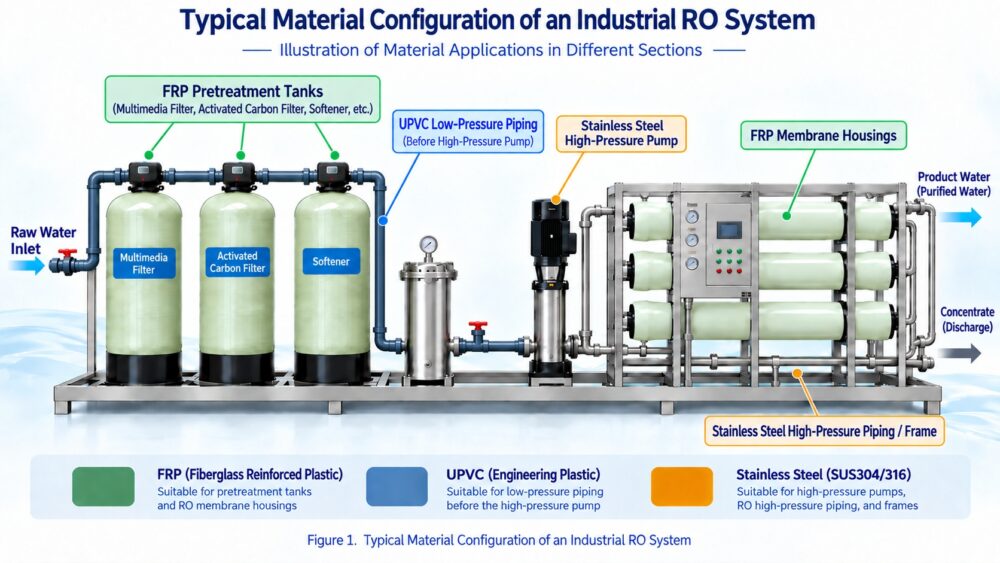
Many well-designed industrial RO systems use a hybrid approach:
FRP for pretreatment filter vessels
UPVC for low-pressure piping
Stainless steel for high-pressure pumps, high-pressure piping, and equipment frames
So the real question isn’t:
“Which is better, FRP or stainless steel?”
It’s:
“For my water quality and application, what’s the best material for each specific location? “
Quick Answer: What Are FRP and Stainless Steel Systems Each Best For?
If you just want the bottom line:
Choose FRP for:
General industrial water treatment
Commercial RO systems
Municipal water or ordinary groundwater
Applications where equipment appearance isn’t critical
Lower initial investment
Good corrosion resistance
Pretreatment filters and softeners
Choose stainless steel for:
Food and beverage production
Cosmetics production
Pharmaceutical applications
High sanitary and appearance requirements
Higher mechanical strength
High-pressure piping and components
Higher overall industrial-grade equipment
But for most ordinary industrial RO projects:
FRP pretreatment + stainless steel high-pressure section + UPVC low-pressure piping
This is often more economical and sensible than “all FRP” or “all stainless steel.”
First, What Exactly Is an “FRP RO System”?
FRP stands for:
Fiber Reinforced Plastic
In the water treatment industry, FRP is extremely common. For example:
- FRP sand filters
- FRP multimedia filters
- FRP activated carbon filters
- FRP water softeners
- FRP RO membrane housings
So when a supplier says “FRP RO System,” they sometimes just mean the pretreatment tanks are made of FRP. It doesn’t mean the entire system’s frame, piping, and high-pressure pump are all FRP.
This is crucial when comparing quotations.
What Is a “Stainless Steel RO System”?
A stainless steel RO system typically means more structural and wetted parts are made of stainless steel, such as:
- Stainless steel frame
- Stainless steel piping
- Stainless steel filter housings
- Stainless steel membrane housings
- Stainless steel water tanks
- Stainless steel high-pressure components
The most common grades are SS304, or SS316 / SS316L for higher requirements.
But again: when a supplier says “stainless steel RO system,” it doesn’t mean every single component is stainless steel. Pretreatment tanks might still be FRP, and some low-pressure piping might still be UPVC.
So when comparing equipment, ask the supplier to clarify:
Which parts are FRP, UPVC, SS304, or SS316?
FRP vs Stainless Steel: Quick Comparison
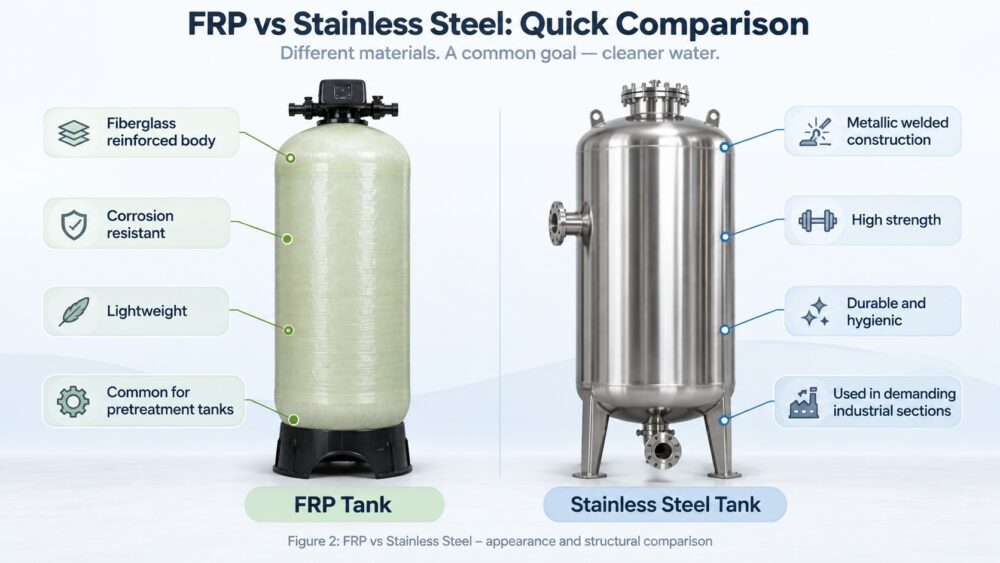
| Comparison Item | FRP | Stainless Steel |
|---|---|---|
| Initial cost | Lower | Higher |
| Corrosion resistance | Very good | Very good, but depends on grade and water quality |
| Weight | Lighter | Heavier |
| Installation | Relatively easy | Usually heavier |
| Mechanical strength | Good | Higher |
| Appearance | Industrial, functional | More professional, premium |
| Sanitary design | Sufficient for general industrial use | Better for high sanitary requirements |
| High-pressure applications | Depends on specialized pressure vessel design | Widely used |
| High-chloride environments | FRP has inherent advantages | Must select correct stainless steel grade |
| Pretreatment filter tanks | Very common | Can be used, but higher cost |
| Food/beverage projects | Can be used | Usually preferred |
| Maintenance | Relatively simple | Requires attention to welds and corrosion |
| Project budget | More economical | Higher investment |
So asking “which is better” is meaningless. Both materials have well-established industrial applications. The key is where you use them.
One of FRP’s Biggest Advantages: Corrosion Resistance
Water treatment equipment is constantly exposed to water, salts, chemicals, and humid environments. Corrosion resistance matters.
FRP doesn’t rust like ordinary carbon steel. That’s why it’s so widely used in water treatment, especially for:
- Multimedia filtration
- Activated carbon filtration
- Ion exchange softening
- RO membrane pressure vessels
For many general industrial and commercial water treatment projects, using FRP doesn’t mean “low-end.” It means using a corrosion-resistant, lightweight, and economical engineering material in the right place.
FRP Is Usually More Economical
For the same size pretreatment system, FRP tanks are usually cheaper than stainless steel pressure tanks. The cost difference becomes more pronounced as equipment size increases.
For example, a 5 TPH or 10 TPH industrial RO system might need multimedia filters, activated carbon filters, and softeners. If all three large pressure tanks were made of stainless steel, the equipment cost would rise significantly. With FRP, you can control the budget while still maintaining good corrosion resistance.
So for general industrial RO projects, budget-sensitive projects, and commercial water treatment, FRP is often a very practical choice.
FRP Is Lighter – Easier to Ship and Install
FRP tanks are typically lighter than metal pressure vessels of the same specification. This brings several practical advantages:
- Easier shipping
- Simpler on-site handling
- Less installation work
- Lower support structure requirements
For export projects, this also directly affects shipping costs. Especially for large industrial systems or multiple large filter tanks shipped together, equipment weight is a real cost factor.
Where Does FRP Fall Short?
FRP isn’t suitable for every location. It has its limitations:
- High temperature: FRP’s temperature tolerance depends on the resin system and product design. Standard FRP tanks can’t be used for high-temperature water.
- Mechanical impact: FRP is structurally adequate for many water treatment applications, but it doesn’t handle severe mechanical impact as well as stainless steel.
- Appearance: Some food, pharmaceutical, and cosmetics plants prefer the look of all-stainless equipment.
- Sanitary requirements: For applications requiring sanitary design, frequent cleaning, or specific surface finishes, stainless steel is usually easier to satisfy.
So FRP’s advantages are clear, but it’s not suitable for every location in the system.
Stainless Steel’s Biggest Advantage: Mechanical Strength and Industrial-Grade Construction
Stainless steel is extremely common in industrial equipment. One of its biggest advantages is mechanical performance.
For high-pressure piping, high-pressure pumps, RO high-pressure sections, equipment frames, and large industrial production lines, stainless steel often provides better structural strength.
At the same time, stainless steel equipment gives customers a more professional, clean, and industrial visual impression. That’s why many food plants, beverage plants, cosmetics manufacturers, and pharmaceutical companies prefer stainless steel configurations.
SS304 and SS316 Are Not the Same Thing
This is critically important when purchasing an industrial RO system.
Many quotations only say “Stainless Steel.” That’s not enough information. The two most common grades are:
SS304
A very common stainless steel. Suitable for general industrial water, food production, beverage production, and low-to-medium chloride environments.
SS316 / SS316L
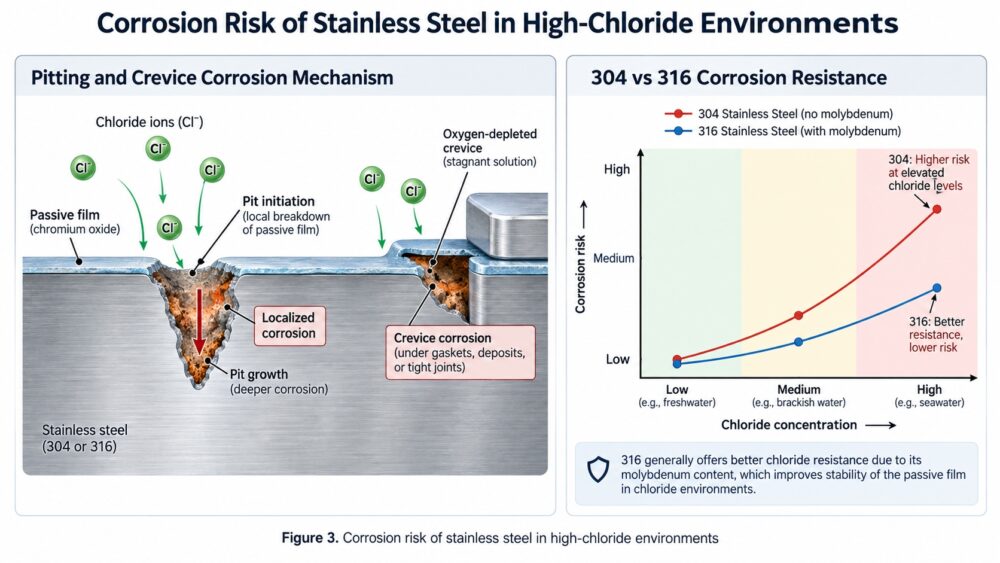
316 contains molybdenum, which provides better corrosion resistance in many chloride-containing environments compared to 304. So for higher-chloride water sources, brackish water, some highly corrosive environments, pharmaceuticals, specialty food production, and higher sanitary requirements, 316 or 316L is usually more suitable.
However, 316 is not “corrosion-proof forever.” If chloride levels are very high, temperatures are elevated, or unfavorable crevice conditions exist, stainless steel can still experience pitting or crevice corrosion.
So for high-chloride water sources, don’t simply assume “switching to 316 solves everything.” Material grade must be selected based on actual water quality and operating conditions.
Why High-Chloride Water Sources Require Special Attention with Stainless Steel
Many customers see “Stainless Steel” and naturally assume “stainless steel doesn’t rust.”
This is a common misconception.
In reality, stainless steel’s corrosion resistance depends on:
- Chloride
- pH
- Temperature
- Oxidizers
- Weld quality
- Surface condition
- Crevice geometry
Under higher chloride conditions, 304 is more susceptible to localized corrosion than 316.
So if your raw water is brackish water, seawater, or high-chloride groundwater, don’t simply specify “Full SS304.” Sometimes that approach is actually less sensible than FRP + appropriate-grade stainless steel + engineering plastics.
How Should Food and Beverage Plants Choose?
This is a common question. The answer: it depends on which part.
For example, a food plant’s pretreatment system can still use FRP multimedia filters and FRP activated carbon filters. The RO main unit might use an SS304 frame, SS304 high-pressure piping, and an SS304 water tank.
This controls equipment cost while making the main equipment area more suitable for food production environments.
So food projects don’t mean every piece of equipment must be all stainless steel. What really matters is:
- Which parts contact the final product water?
- Are there sanitary standards?
- Is CIP required?
- What are the customer’s internal plant specifications?
- What do local regulations require?
How Should Cosmetics Projects Choose?
Cosmetics production typically has higher requirements for product water quality, sanitary conditions, equipment cleaning, and microbial control.
So in many cosmetics projects, we lean toward: stainless steel RO main unit + stainless steel purified water tank + sanitary-grade post-treatment. Pretreatment can use FRP or stainless steel depending on the situation.
If the project also involves double-pass RO, EDI, UV, ozone, or sanitary loop piping, the proportion of stainless steel typically increases further.
Pharmaceutical Projects Usually Lean Toward Stainless Steel
Pharmaceutical projects typically have significantly higher requirements than general industrial water treatment. Beyond water quality, they may involve:
- Sanitary design
- Surface finish
- Dead leg control
- CIP (Clean-in-Place)
- SIP (Sterilization-in-Place)
- Validation
- Documentation
So an ordinary FRP industrial system and a pharmaceutical purified water system can’t simply be compared side by side. Many pharmaceutical systems use large amounts of SS316L with sanitary welding and surface treatment.
If a customer tells a supplier “The water is for pharmaceutical production,” the equipment design logic should be completely different from an ordinary industrial RO project.
How Should High-Hardness Groundwater Be Handled?
If the raw water is high-hardness well water, the real priority isn’t “FRP or stainless steel” – it’s how to solve scaling.
You may need:
- Multimedia filter
- Softener
- Antiscalant
- Cartridge filter
- Reasonable RO recovery rate
In these projects, FRP softener tanks and FRP filter tanks are very common, while the RO high-pressure section can continue to use stainless steel.
So for ordinary high-hardness well water projects, hybrid material design is often very sensible.
How Should Brackish Water and Seawater Be Handled?
This is where material selection becomes even more important, because chloride concentration increases, especially in seawater systems.
You can’t simply copy the material design from an ordinary tap water RO system. You may need to consider:
- FRP pressure vessels
- Duplex stainless steel
- Higher-alloy stainless steel
- Special plastic piping
- Corrosion-resistant pumps
The specific design must be based on chloride, pressure, temperature, and chemical environment.
So “Stainless Steel is always better for seawater” is not accurate.
Does an FRP RO System Always Have a Shorter Lifespan Than Stainless Steel?
Not necessarily.
Material lifespan depends on:
- Product quality
- Pressure rating
- Temperature
- Chemical compatibility
- Installation
- Operating environment
- Maintenance
High-quality FRP pressure vessels are specifically developed for long-term water treatment applications. Similarly, stainless steel can also suffer corrosion problems if the grade is inappropriate, weld quality is poor, or it’s exposed to unsuitable chloride environments long-term.
So:
Material name alone does not determine system life.
Is a Stainless Steel RO System Always Better Than FRP?
Not necessarily.
If an ordinary 5,000 LPH industrial RO system treats municipal tap water, and the customer has no special sanitary, high-temperature, or appearance requirements, then switching all large pretreatment tanks to stainless steel might just add project cost.
That extra budget might be better spent on:
- Better RO membranes
- More reliable pumps
- More rational pretreatment
- Online conductivity monitoring
- PLC
- Spare consumables
So:
More stainless steel does not automatically mean a better RO system.
Why Is FRP + Stainless Steel Hybrid Configuration So Common?
For many industrial RO systems, this is a concept every buyer should understand.
A typical system might look like:
Pretreatment
- FRP multimedia filter
- FRP activated carbon filter
- FRP water softener
Low-pressure piping
- UPVC
RO section
- SS304 frame
- Stainless steel high-pressure pump
- SS304 / SS316 high-pressure piping
- FRP RO pressure vessels
Product water
- SS304 / SS316 tank (depending on final water use requirements)
The beauty of this design: use FRP where corrosion resistance and economy are needed, and stainless steel where mechanical strength and sanitary grade are required.
The result: Performance + Reliability + Cost Balance.
Which System Is Easier to Maintain?
This also can’t be answered simply.
FRP
Pros: No worry about ordinary rust, lightweight, relatively easy to replace.
Watch out for: Avoiding severe impact, regularly inspecting tanks, connections, and valves.
Stainless Steel
Pros: High structural strength, easy to clean, maintains a professional appearance.
Watch out for: Checking welds, surfaces, corrosion, passivation condition, and chloride exposure.
So both systems require maintenance. The difference is just what you focus on.
How Much Price Difference Between FRP and Stainless Steel?
There’s no fixed answer. Cost mainly depends on:
- System capacity
- Number of FRP tanks
- Proportion of stainless steel used
- 304 or 316
- Pipe size
- Pressure rating
- Welding requirements
- Surface treatment
- Automation level
Generally, FRP pretreatment has a lower initial cost than stainless steel pretreatment of the same specification, and SS316 is usually more expensive than SS304.
But when purchasing, don’t just compare total price. Compare:
Same configuration + Same material grade + Same scope
How to Choose Quickly Based on Application?
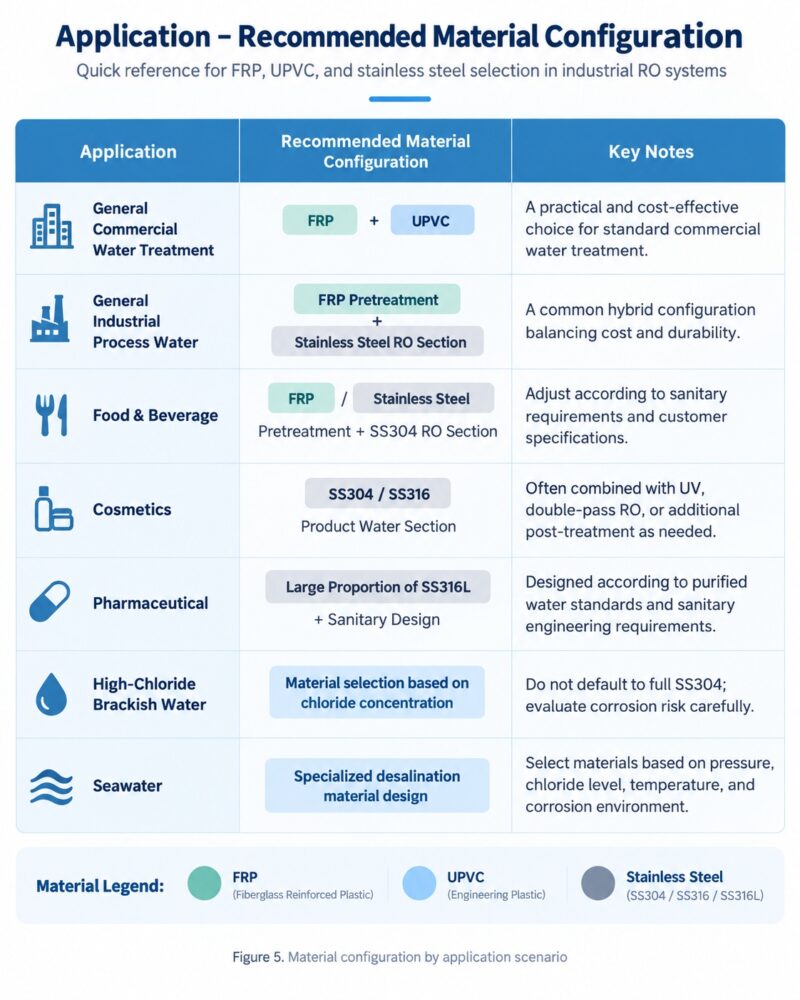
- General commercial water treatment: FRP + UPVC is already very suitable.
- General industrial process water: FRP pretreatment + stainless steel RO section.
- Food & beverage: FRP/stainless steel pretreatment + SS304 RO section, adjusted per customer sanitary specifications.
- Cosmetics: Lean toward SS304/SS316 product water section, with UV, double-pass RO, or other post-treatment as needed.
- Pharmaceutical: Design according to specific pharmaceutical purified water standards, using large amounts of SS316L + sanitary design.
- High-chloride brackish water: Must select materials based on chloride concentration. Don’t default to “Full SS304.”
- Seawater: A specialized seawater desalination project. Materials must be designed based on pressure + chloride + temperature + corrosion environment.
What Should You Ask a Supplier When Requesting a Quote?
If you’re comparing FRP and stainless steel RO systems, at minimum confirm:
- Which parts are FRP?
- Which parts are UPVC?
- Which parts are stainless steel?
- Is the stainless steel SS304 or SS316?
- What is the material of the high-pressure piping?
- What is the membrane housing material?
- What is the frame material?
- What is the pretreatment tank material?
- What is the product water tank material?
- Is the material suitable for my chloride level?
- What is the design pressure?
- What is the maximum operating temperature?
- Is the system suitable for my application?
- Are welding and surface treatment included?
- Which materials are in direct contact with product water?
If a supplier only writes “Stainless Steel RO System” without telling you which grade and which parts, that quotation isn’t complete enough.
So, FRP or Stainless Steel in the End?
If you need a simple answer:
- General commercial and industrial projects: FRP is usually very practical.
- Food, beverage, cosmetics, and higher sanitary requirement projects: Stainless steel proportion typically increases.
- High-chloride water sources: Don’t assume stainless steel is always better. Select materials based on the specific corrosion environment.
- Most industrial RO projects: Hybrid material configuration is usually the most sensible.
So the real choice isn’t:
FRP vs Stainless Steel
It’s closer to:
FRP + Stainless Steel: Where should each material be used?
Bottom Line
FRP and stainless steel are both mature water treatment engineering materials. No single material suits every RO project.
FRP’s main advantages: Corrosion resistance, lightweight, economical, ideal for pretreatment and pressure vessels.
Stainless steel’s main advantages: Mechanical strength, sanitary performance, industrial appearance, and high-pressure component applications.
Professional industrial RO system design shouldn’t simply chase “More Stainless Steel,” nor should it cut costs by “Using FRP Everywhere.”
The more rational approach: Select the right material for each part of the system based on raw water, pressure, sanitary requirements, chloride, final water quality, and budget.
Because the ultimate goal isn’t buying an “FRP system” or a “stainless steel system.” It’s:
A reliable RO system designed for your actual water and application.
Not Sure Whether to Choose FRP or Stainless Steel?
If you’re planning an industrial RO project, prepare:
Water Analysis Report + Water Source + Required Capacity + Final Water Application + Project Country
Send it to Aquaclarion.
We can help determine which parts are better suited for:
FRP, UPVC, SS304, or SS316 – based on your water quality, chloride levels, system pressure, sanitary requirements, and project budget.
Need Help Selecting Materials for Your RO System?
Send AquaClarion your water analysis, source-water type, required capacity, final water application, and project country. We can recommend where FRP, UPVC, SS304, or SS316 offers the best engineering and cost balance.
Discuss Your RO Project