Reverse Osmosis Fundamentals
Reverse Osmosis Explained in Plain Language
A visual, practical guide to osmosis, reverse-osmosis pressure, membrane-sheet construction, spiral-wound elements, separation performance, and real-world RO applications.
| Concept | Plain-language meaning |
|---|---|
| Osmosis | Water naturally moves toward the more concentrated solution through a semipermeable membrane. |
| Reverse osmosis | Applied pressure reverses that direction and produces purified permeate. |
| RO membrane sheet | A thin polyamide separation layer supported by porous structural layers. |
| Membrane element | Membrane leaves and spacers wound around a permeate collection tube. |
| Main applications | Drinking water, industrial process water, pharmaceuticals, reuse, and desalination. |
If you’ve ever dealt with water purification equipment, you’ve certainly heard the terms “reverse osmosis” or “RO membrane.” But if someone actually asks you to explain the principle behind reverse osmosis, many people might struggle to give a clear answer.
Today, we’ll explain reverse osmosis from start to finish in the most down-to-earth, plain language. The article isn’t long, but after reading it, you’ll feel confident the next time you discuss RO with others.
What Is Osmosis?
To understand “reverse osmosis,” you first need to understand “osmosis.”
Osmosis refers to the following: when two solutions of different concentrations are separated by a semipermeable membrane, water molecules spontaneously move from the lower-concentration side to the higher-concentration side. In other words, water flows from the side with “higher water potential” through the semipermeable membrane to the side with “lower water potential.”
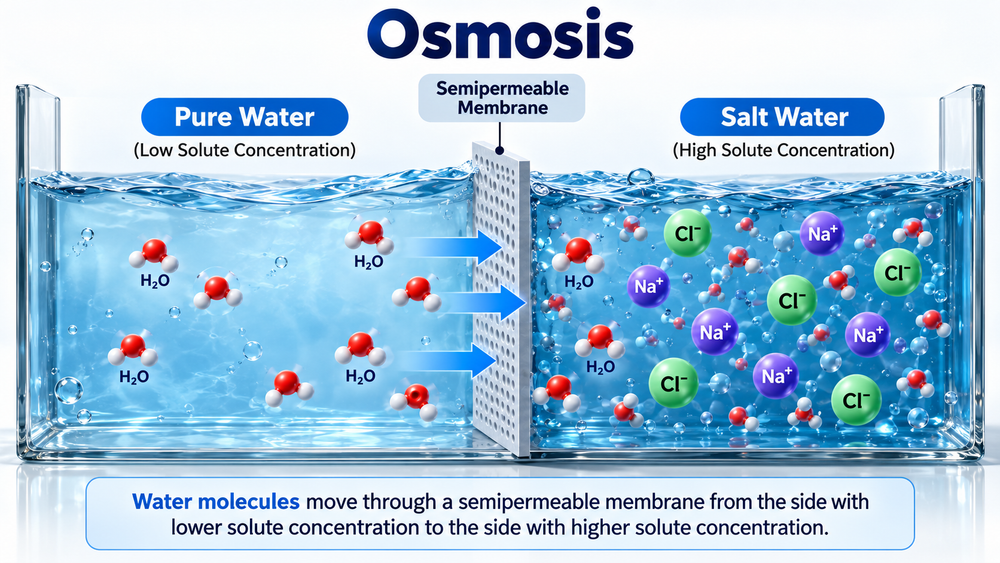
An everyday example:
If you soak a stalk of green vegetable in fresh water, after a while the leaves become crisp and firm. This is because the fresh water has a low concentration while the inside of the vegetable cells has a high concentration, so water automatically “runs” into the cells. This is osmosis.
What Is Reverse Osmosis?
Reverse osmosis (RO for short) is even easier to understand.
Since water spontaneously flows from low concentration to high concentration, what happens if we do the opposite—apply a pressure greater than the osmotic pressure on the side containing salt water?
Water will be “forced” to pass through the membrane from the high-concentration side to the low-concentration side. Meanwhile, the salts, ions, organic matter, and other “big guys” in the water can’t get through and are left behind.
The result: one side is clean pure water, and the other side is concentrated salt water. This achieves desalination of the aqueous solution.
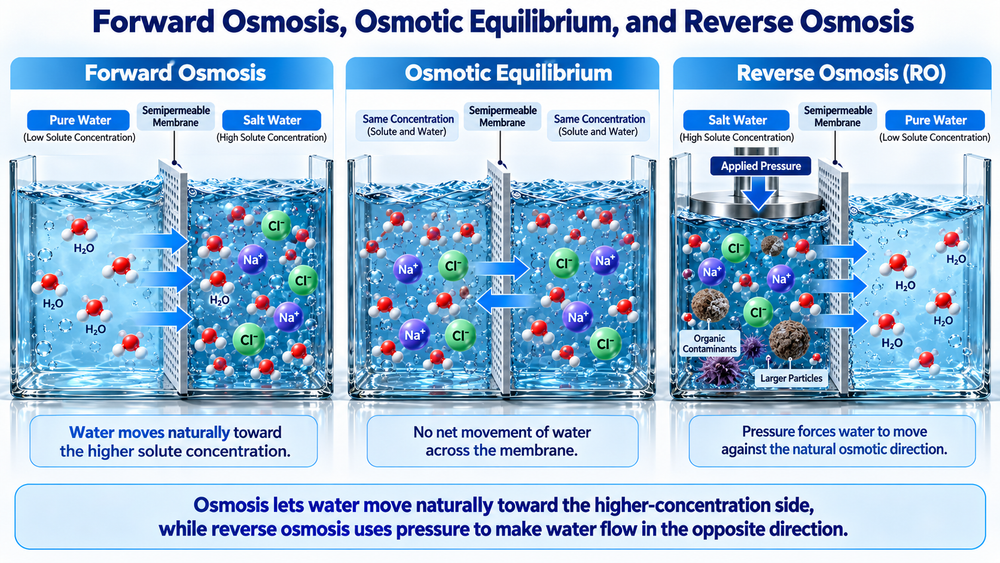
In one sentence: osmosis is water “flowing upward” on its own; reverse osmosis is applying pressure to make water “flow upstream.”
Osmosis in Daily Life: Why IV Drips Use Isotonic Solutions
Osmosis isn’t only used in industry—we encounter it often in daily life.
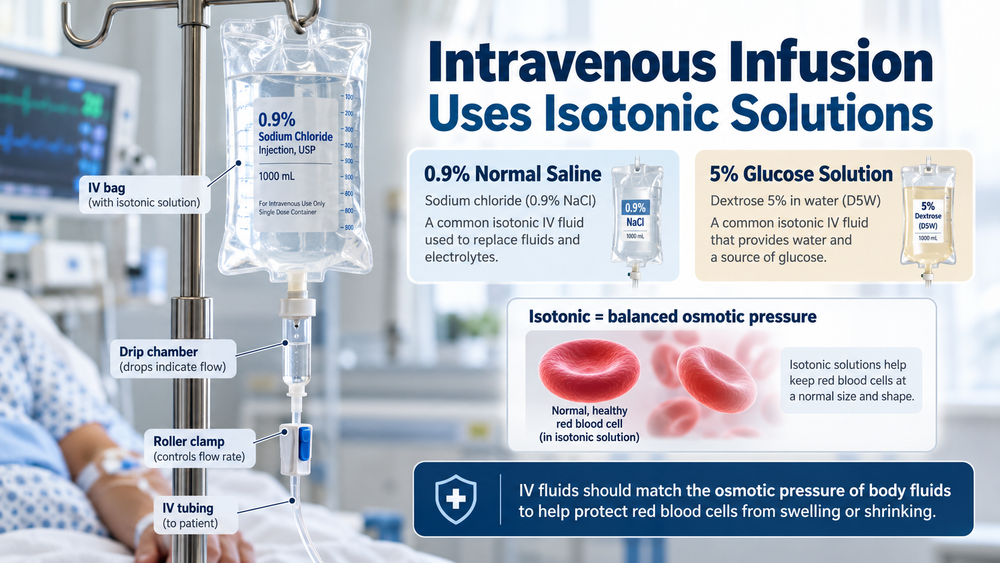
For example, when receiving an IV drip (intravenous infusion) at the hospital, an isotonic solution with the same osmotic pressure as human body fluids must be used. Clinically, 0.9% normal saline or 5% glucose solution is commonly used.
Why is this necessary? Because if the concentration of the infused liquid differs from that of the blood, red blood cells will either burst or shrivel due to osmosis—and that would be a serious problem.
So you see, the principle of osmosis isn’t far from us at all.
What Is a Reverse Osmosis Membrane?
The reverse osmosis membrane is the core component that makes reverse osmosis possible.
It is essentially an artificial semipermeable membrane modeled after biological semipermeable membranes, with certain specific characteristics. It is generally made from polymer materials, such as:
- Cellulose acetate membrane
- Aromatic polyamide membrane
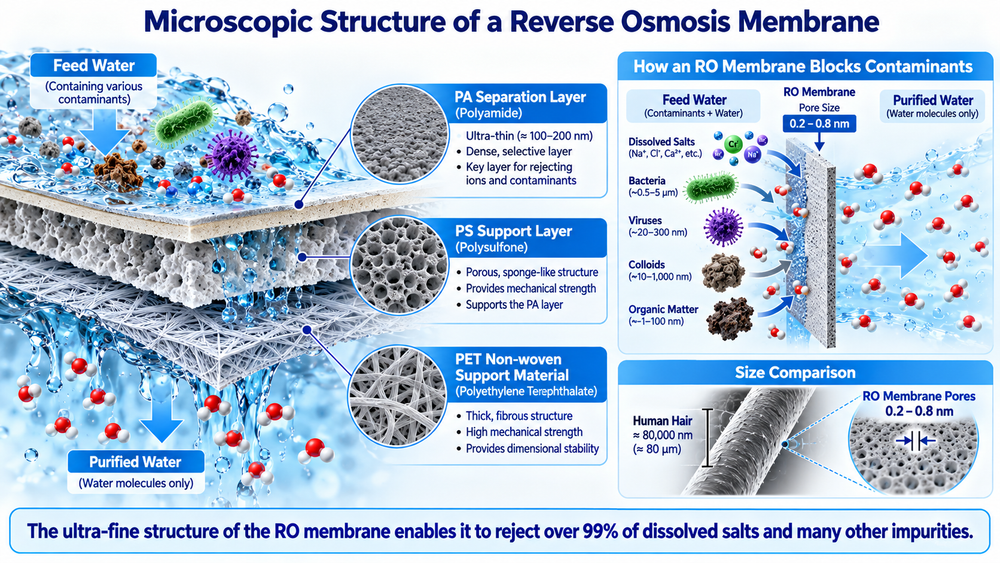
The pore size of a reverse osmosis membrane is extremely small—only 0.2–0.8 nanometers. What does that mean? The diameter of a human hair is about 80,000 nanometers, which means the pore size of an RO membrane is tens of thousands of times finer than a hair.
Because the pores are so small, its separation performance is extremely strong, with a salt rejection rate exceeding 99%. Therefore, it can effectively remove from water:
- Dissolved salts
- Bacteria
- Viruses
- Colloids
- Organic matter and other impurities
How Is an RO Membrane Sheet Made?
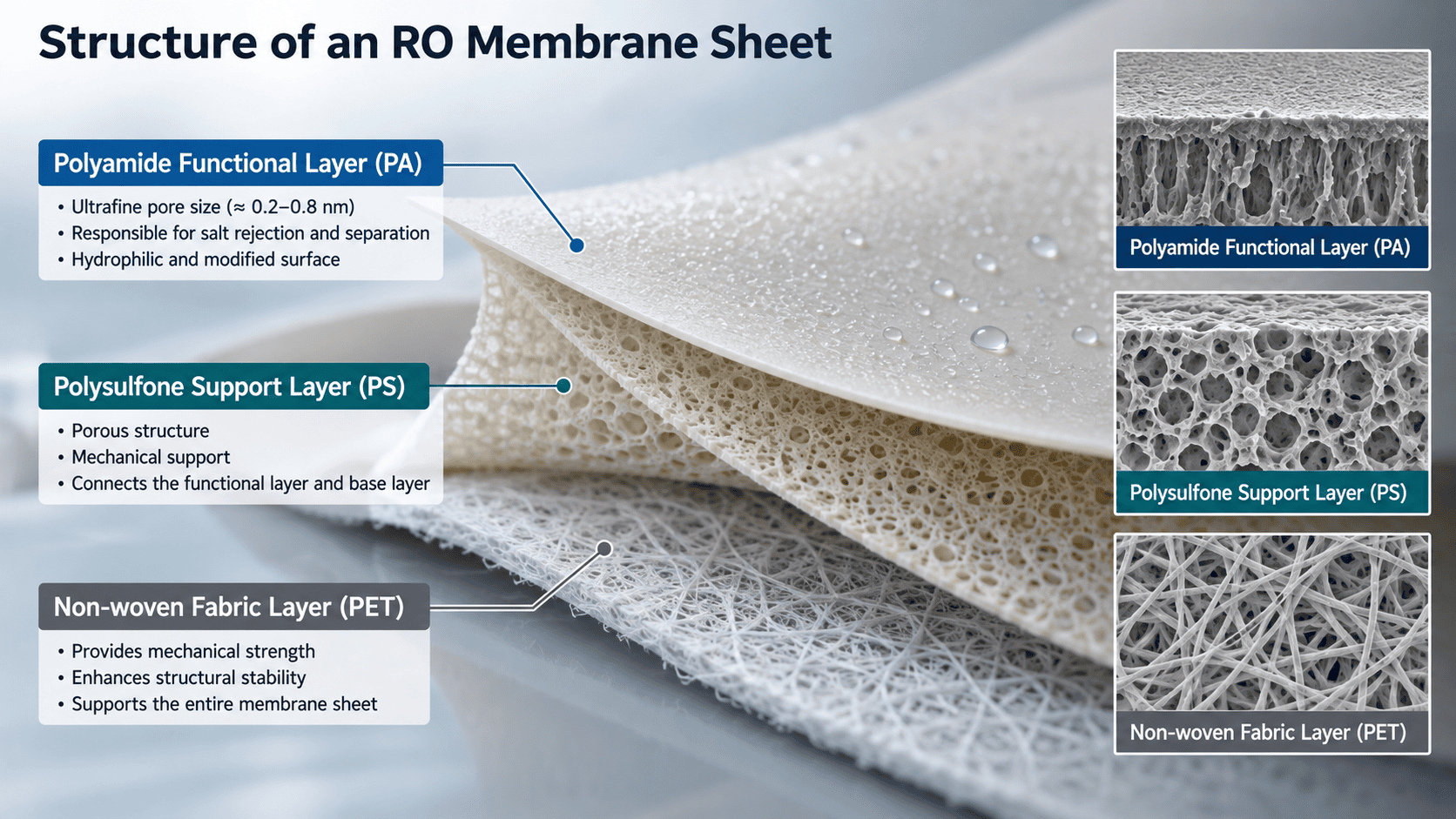
A reverse osmosis membrane sheet is not simply a single layer of membrane; it is composed of multiple layers:
- Non-woven fabric base layer: the bottom layer, providing mechanical support
- Polysulfone support layer: the middle layer, bridging the layers above and below
- Polyamide functional layer: the top layer, truly responsible for separation and desalination
Among these, the polyamide functional layer is the core. To make the membrane more effective, the membrane surface also undergoes modification treatment:
- Changing the charge properties and smoothness of the membrane surface
- Increasing the hydrophilicity of the membrane surface
The benefit of doing this is: reducing the adhesion of pollutants and microorganisms on the membrane surface, thereby lowering the fouling rate of the membrane element and extending its service life.
How Is an RO Membrane Element Constructed?
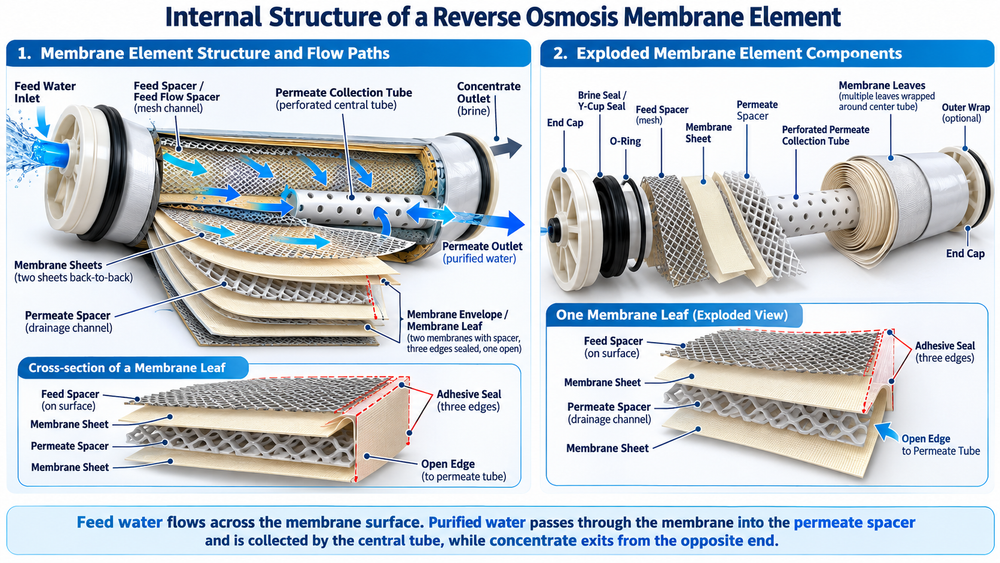
What we commonly call a “membrane element” is actually composed of multiple leaf-shaped membrane bags.
The structure of each membrane bag is as follows:
- Two membrane sheets placed back to back
- A permeate spacer in between
- A feed spacer channel laid on the membrane surface
- The three sides of the membrane bag are sealed with adhesive, with the fourth side open
- The open side is connected to a perforated permeate collection tube
The advantage of this design is: feed water enters from one end, passes through the membrane and becomes permeate, which flows out through the central permeate collection tube; the concentrate is discharged from the other end.
Where Are Reverse Osmosis Membranes Used?
Reverse osmosis separation technology is essentially a new type of separation technology that uses differences in the selective permeability of a membrane to various components of a mixture to achieve separation, purification, or concentration.
It is widely used in:
- Drinking pure water: household and commercial water purification equipment
- Food and beverages: beverage water, juice concentration
- Medical and pharmaceutical: pharmaceutical purified water, water for injection
- Municipal water supply treatment: advanced treatment of tap water
- Industrial high-purity water: boiler make-up water for the electronics and power industries
- Boiler feed water: preventing boiler scaling
- Seawater desalination: solving water shortages in coastal areas
- Ultrapure water for the electronics industry: chip manufacturing
- Wastewater treatment and reuse: reclaimed water reuse, zero discharge
- Material concentration and purification: food, chemical, biopharmaceutical
It can be said that wherever there is a need to “separate water from impurities,” reverse osmosis membranes are almost always present.
Key Takeaways
Reverse osmosis is a technology that is complex if you make it complex, and simple if you make it simple. Remember these few sentences, and you’ll grasp the core:
- Osmosis: water spontaneously flows from low concentration to high concentration.
- Reverse osmosis: apply pressure to make water flow from high concentration to low concentration, thereby achieving desalination.
- Reverse osmosis membrane: pore size only 0.2–0.8 nanometers, salt rejection rate exceeding 99%, the core of reverse osmosis technology.
- Membrane sheet structure: non-woven fabric base layer + polysulfone support layer + polyamide functional layer.
- Membrane element: composed of multiple leaf-shaped membrane bags wound around a permeate collection tube.
- Applications: from household water purification to seawater desalination, from food and beverages to electronics and pharmaceuticals—everywhere.
If you are planning a water treatment project or have questions about reverse osmosis membrane selection, please feel free to contact us anytime. We can help you find the most suitable membrane products and system solutions based on your actual water quality and water use needs.
Planning an RO Water Treatment Project?
Share your source-water analysis, required capacity, product-water target, application, and project country. AquaClarion can help match the membrane, pretreatment, recovery rate, and system configuration to your actual operating conditions.
Discuss Your RO Project