
RO Membrane Technical Guide
Troubleshoot low salt rejection systematically before deciding whether membrane replacement is necessary.
If you run a reverse osmosis system, you already know that one indicator tells you almost everything about performance: salt rejection. It measures how effectively the membrane holds dissolved salts back from the permeate — the more salts rejected, the purer the product water. When salt rejection drops, permeate conductivity climbs immediately, and every downstream process that depends on that water starts to suffer.
The natural reaction? “The membranes are finished — time to replace them.”
Not so fast. Salt rejection is not only about the membrane element itself. Installation quality, feed water conditions, and day-to-day operation all play a role. To make troubleshooting systematic, we’ve organized the 11 most common causes into two scenarios: salt rejection that fails to meet spec right from startup, and salt rejection that declines gradually after stable operation.
Part 1 — Low Salt Rejection Right From Startup
1. Un-calibrated instruments — the readings themselves are wrong
What’s happening: If the conductivity meter or TDS meter used to measure permeate conductivity (or TDS) hasn’t been calibrated, the readings can be way off, and the calculated salt rejection will naturally appear “artificially low.” It’s like weighing goods on an inaccurate scale — suspect the scale first, not the goods.
What to do: Calibrate your instruments first and confirm the data is trustworthy before moving on to any further troubleshooting.
2. O-ring leaks — poor sealing lets concentrate “cross over” into the permeate
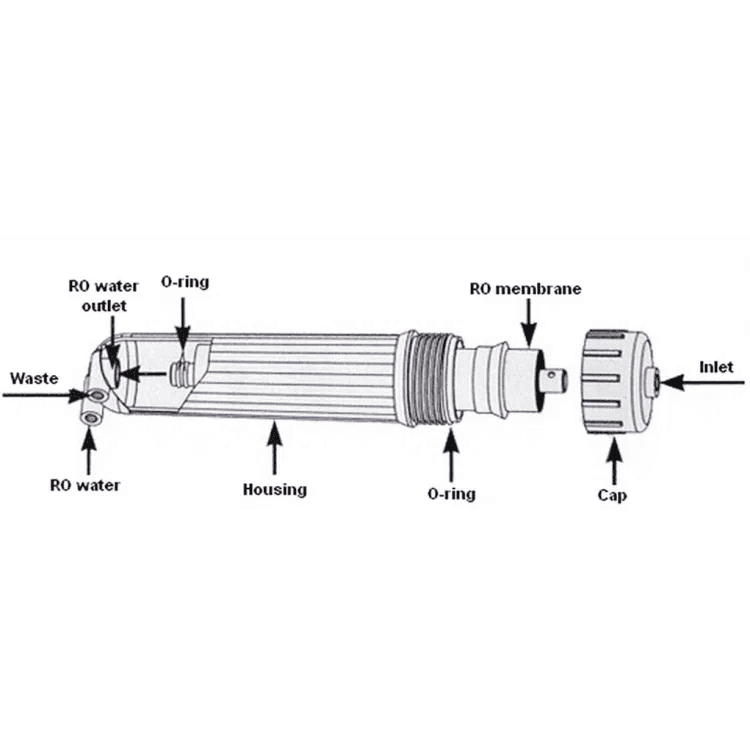
First, some background: O-rings are the rubber sealing rings on the inter-element connectors between membrane elements, as well as on the end-cap adapters of the membrane housings (pressure vessels).
What’s happening: During membrane installation, if an O-ring on a connector gets twisted or dislodged, the seal fails — and concentrate that hasn’t been fully filtered leaks straight into the permeate line. How could the measured salt rejection possibly look good?
What to do: Measure the permeate conductivity of each membrane housing one by one; whichever one reads abnormally, investigate that one. Once you’ve identified the problem housing, inspect and replace the damaged permeate seal inside it.
3. Wrong membrane selection — failing to match the membrane to the water
What’s happening: The membrane was chosen without looking at the feed water quality, so the membrane and the water source are mismatched — and the salt rejection simply can’t reach expectations.
What to do: Don’t guess when it comes to selection. Talk to a technical specialist and choose the right membrane element model for your specific water source (figure out which series you actually need — ULP / LP / FR / BW, and so on).
4. The feed water itself isn’t “cooperating”
What’s happening: Two scenarios are most common:
- Feed water temperature too high: Once the inlet temperature rises, salt ions “slip through” the membrane faster, which shows up as a drop in salt rejection.
- High proportion of hard-to-reject ions: Feed water with elevated levels of ions that are inherently difficult to remove — such as CO₂ and nitrates — or an excessively high or low pH, will drag down the overall salt rejection.
What to do: Switch to a more suitable feed water source, or adjust the operating process.
5. Back-pressure damage — permeate “pushing back” against the concentrate has crushed the membrane
First, some background: Back-pressure is when the pressure on the permeate side exceeds the pressure on the concentrate side, damaging the membrane element’s separation layer.
What’s happening: Once back-pressure occurs, the membrane’s salt-rejecting layer (the separation layer) is destroyed. This is irreversible damage — no amount of process adjustment will bring it back.
What to do: First eliminate the source of the back-pressure fault, then replace the membrane element with a new one directly. Don’t hold out any hope of recovery.
Part 2 — Salt Rejection Declining Gradually After Stable Operation
If salt rejection keeps falling even after the system has settled into stable operation, focus your suspicion on these six categories: oxidation, back-pressure, excessive differential pressure, abrasion, fouling, and changes in the feed water source.
1. The membrane has been oxidized — a “terminal illness” that can only be prevented
What’s happening: Membrane oxidation is irreversible chemical damage. Once it strikes, salt rejection is permanently reduced. The most common cause: before installing the membranes, no one verified whether the pretreatment effluent met spec — and water with excessive residual chlorine or other oxidants flowed straight into the membrane system.
First, some background: Residual chlorine is the disinfectant left over in tap water (the source of that “bleachy” smell). It’s safe for humans, but it’s “poison” to the membrane.
What to do: Adjust the operating process and strictly guard against excessive residual chlorine in the RO feed, keeping the oxidation risk out of the membranes. Membranes that have already been oxidized can only be replaced.
2. Back-pressure again — the “invisible killer” during startup and shutdown
What’s happening: During operation, if permeate pressure exceeds feed or concentrate pressure by just 0.3 bar, the composite layers of the membrane element can be “pried apart” (delaminated). This is back-pressure damage, and salt rejection drops accordingly. Pay special attention: at the moment of system startup and shutdown, pressures fluctuate sharply from stage to stage — a high-risk window for back-pressure damage. There’s also a pattern to back-pressure damage: it tends to occur first on the membrane element closest to the concentrate outlet within each housing.
What to do: A two-step approach —
- Eliminate the back-pressure source: Identify what’s causing the back-pressure and cut it off at the root by adjusting the startup/shutdown sequence or the process piping.
- Replace the membranes promptly: Back-pressure damage is irreversible. Once the source is resolved, replace the damaged membrane elements so they don’t drag down the entire membrane train.
3. “Telescoping” — the membrane has been crushed out of shape
First, some background: Telescoping refers to the situation where an excessive differential pressure between the feed side and the concentrate side squeezes the membrane element stage by stage into a deformed shape (looking like a collapsed telescope tube). It is a form of mechanical damage.
What’s happening: When the two-stage pressure differential stays too high for too long, the membrane element can’t withstand it, the structure gets crushed, and salt rejection declines.
What to do: Make a habit of reviewing operating data. When the differential pressure exceeds 15% of the initial value, take corrective action promptly and schedule a chemical cleaning — and never exceed the maximum differential pressure allowed by the equipment, at any time.
4. The membrane surface has been scratched by particles — like it was sanded down
What’s happening: Particles in the water scrape across the membrane surface, leaving damage and reducing salt rejection. Two high-risk scenarios: first, sharp particles break through the upstream filtration and enter the membrane element; second, when cleaning a scaled membrane element, starting with a high flow rate right away — the dislodged crystalline deposits then abrade the membrane surface like sandpaper.
What to do:
- Maintain the security filter diligently (that’s the “gatekeeper” screen installed in front of the membranes) and keep sharp particles out.
- When cleaning a scaled membrane, start with a low flow rate — let the cleaning chemicals soften the scale layer first, then gradually increase the flow.
5. Membrane fouling — after long operation, the membrane gets “dirty”
What’s happening: Even with well-designed pretreatment, membrane systems inevitably get slowly smothered by foulants over long-term operation (inorganic scale, organics, colloids, biofilm, etc.). The symptoms are reduced salt rejection and declining permeate flow.
What to do: Perform chemical cleaning to restore performance. Regular cleaning isn’t just about rescuing salt rejection — it’s routine maintenance that extends membrane life.
6. Feed water quality has changed — the source has “swapped the recipe”
What’s happening: The feed water quality undergoes seasonal or sudden changes that exceed the membrane system’s original design assumptions, and salt rejection drops as a result.
What to do: Either switch to a different feed water source, or adjust the membrane system’s treatment process so the process matches the current water quality again.
When Should You Actually Replace the Membranes?
Only two conditions make replacement unavoidable: oxidation (chemical destruction) and back-pressure / mechanical damage (physical delamination or telescoping). Everything else can be diagnosed and corrected without touching the membranes — which is why a systematic check before replacement routinely saves both downtime and money.
Frequently Asked Questions
If salt rejection is low, does that mean the membranes must be replaced?
Not necessarily. Instrument error, O-ring leaks, improper selection, or feed water fluctuations can all be corrected. Only irreversible damage — oxidation or back-pressure — truly requires replacement.
Why are back-pressure damage and oxidation irreversible?
Back-pressure physically delaminates the membrane’s layered structure; oxidation chemically destroys the material. Both compromise the membrane body itself — no cleaning or process adjustment can repair them.
At what point does differential pressure require action?
When it exceeds 15% of the initial value. Never exceed the equipment’s maximum allowable differential pressure, to prevent telescoping.
How can back-pressure damage during startup be prevented?
Standardize the startup/shutdown procedure. If rejection becomes abnormal, inspect the element closest to the concentrate outlet in each housing first.
What should I watch out for when cleaning membranes?
Start at a low flow rate to prevent dislodged crystals from scratching the membrane, and maintain the security filter diligently.
Need Help Diagnosing Low Salt Rejection?
Share your feedwater and permeate conductivity, pressures, and operating history with AquaClarion to discuss the next troubleshooting steps.
Discuss Your RO System