
RO Membrane Technical Guide
Cold Weather Changes Performance—Not Necessarily Membrane Health
A practical winter operating and freeze-protection guide for understanding lower permeate flow, managing temperature safely, and protecting RO membranes during operation, shutdown, storage, and restart.
| Condition | Recommended action |
|---|---|
| Feedwater below 10°C | Consider controlled heating; approximately 20–25°C is a practical target |
| Operating environment | Maintain above 5°C where specified for the system |
| Wet element / shutdown storage | Keep between 5°C and 45°C; prevent freezing |
| Frozen element | Thaw slowly, confirm all ice is gone, then restart carefully |
| Outdoor equipment below 0°C | Use adequate freeze protection or stop operation |
What Happens to RO Membranes in Winter?
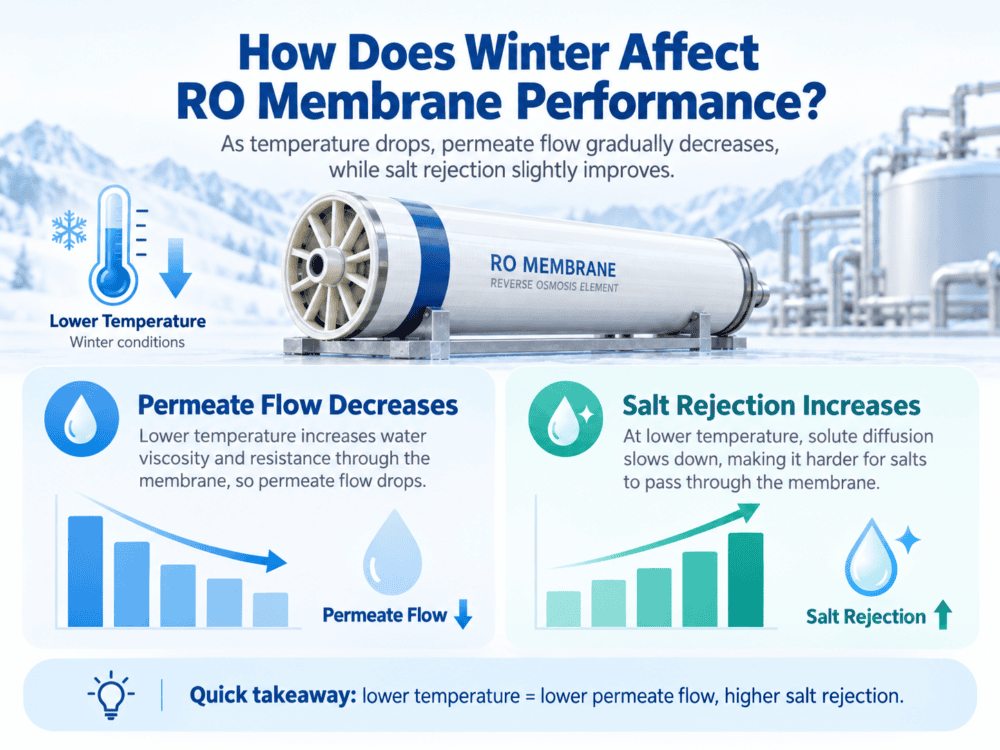
The most common winter performance change is simple:
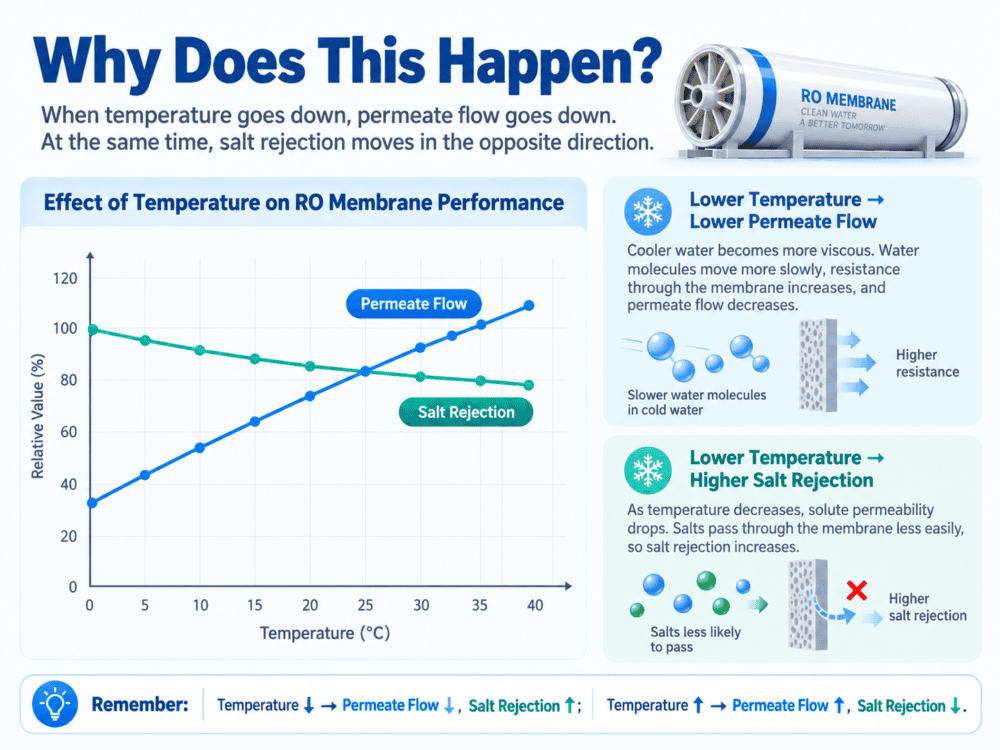
Lower temperature → lower permeate flow
At the same time:
Lower temperature → slightly higher salt rejection
This is the normal winter pattern: water production decreases while rejection performance may improve slightly.
At first, this may seem contradictory.
If the RO system is producing better-quality water, why is it producing less water?
The answer lies in how temperature affects water viscosity and solute transport through the membrane.
2. Why Does RO Permeate Flow Decrease in Cold Weather?
As water temperature drops, water becomes more viscous.
In simple terms, colder water is more difficult to push through the membrane.
Water molecules move more slowly, and resistance through the membrane increases. As a result, the amount of permeate produced by the RO system decreases.
This is why an RO system operating normally in summer may produce noticeably less water during winter, even when the membrane itself is still in good condition.
Colder water is more viscous and molecular movement slows, reducing water passage through the membrane.
What Does This Mean for Operators?
If permeate flow decreases during winter, do not immediately assume that:
- the membrane is fouled,
- the membrane is damaged,
- or the membrane needs replacement.
Check the feed water temperature first.
Temperature should always be considered when comparing RO production data from different seasons.
3. Why Can Salt Rejection Improve at Lower Temperature?
Temperature affects dissolved salts as well.
At lower temperatures, solute permeability decreases. Dissolved salts have more difficulty passing through the RO membrane into the permeate stream.
As a result, salt rejection may improve slightly.
This creates the typical winter pattern:
Lower temperature = lower permeate flow + higher salt rejection
The reverse generally applies as temperature increases:
Higher temperature = higher permeate flow + lower salt rejection
This is a physical temperature effect, not by itself evidence of a membrane fault.
4. RO Membrane Winter Maintenance During Normal Operation
During winter operation, temperature management becomes especially important.
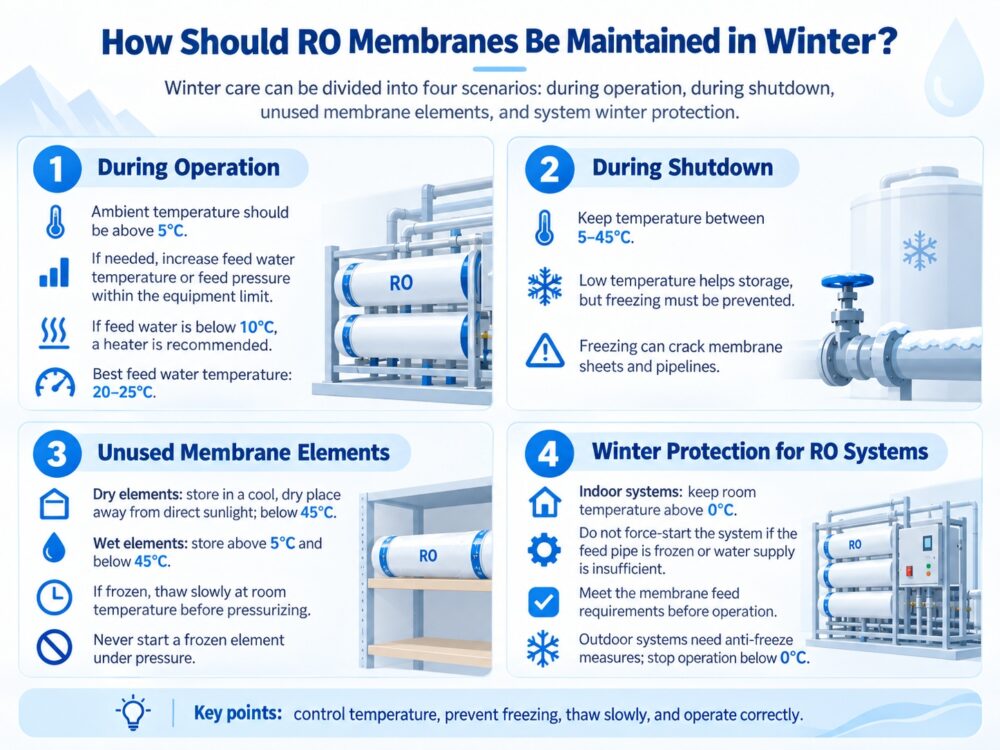
For winter operation, the ambient temperature should remain above 5°C during operation.
If the temperature becomes too low, system operating risk increases.
Maintain an Appropriate Operating Temperature
Where possible, increase the feed water temperature.
Consider feedwater heating when the raw water temperature falls below 10°C, with a target water temperature of approximately:
20–25°C
This range is presented in the source as a more comfortable operating range for the RO system.
Feed Pressure Can Also Be Adjusted Carefully
Operators may consider adjusting feed pressure to compensate for reduced permeate flow.
However, pressure should never be increased blindly.
Any pressure adjustment must remain within the safe operating limits of:
- the RO membrane,
- pressure vessels,
- pumps,
- piping,
- valves,
- and the overall RO system design.
The key principle is:
Do not compensate for low temperature by simply forcing the system to operate at excessive pressure.
5. RO Membrane Protection During System Shutdown
Winter shutdown requires different precautions from normal operation.
Keep the membrane storage or shutdown environment between:
5°C and 45°C
Lower temperatures can be suitable for membrane preservation, but the system must not be allowed to freeze.
Why Is Freezing Dangerous?
Water expands when it freezes.
If water remains inside:
- membrane housings,
- membrane elements,
- pipes,
- valves,
- fittings,
- or other system components,
freezing can cause physical damage.
Freezing can rupture membrane sheets and piping, potentially causing irreversible damage.
For this reason, freeze protection is one of the most important parts of RO winter maintenance.
6. How Should Unused RO Membrane Elements Be Stored?
Unused membrane elements should also be protected from extreme temperatures.
Dry Membrane Elements
Dry membrane elements should be stored:
- in a cool location,
- in a dry environment,
- away from direct sunlight,
- and below 45°C.
Wet Membrane Elements
Wet membrane elements should be stored between:
5°C and 45°C
Dry and wet membrane elements have different storage requirements, but both must be protected from excessive heat and freezing.
7. What Should You Do If an RO Membrane Freezes?
This is one of the most important winter maintenance rules:
Do not immediately pressurize a frozen membrane element.
If a membrane has frozen, allow it to thaw slowly at room temperature.
Only restart the system after the membrane has completely thawed.
Do not apply pressure to a frozen membrane; remaining ice may damage the membrane surface.
A simple rule to remember:
Frozen membrane → thaw slowly → confirm no ice remains → restart carefully
Never try to “force” a frozen RO system back into operation.
8. Winter Protection for Indoor RO Systems
For indoor RO equipment, keep the room temperature above:
0°C
If necessary, use appropriate heating or insulation measures to prevent freezing.
Pay particular attention to:
- feed water pipes,
- small-diameter tubing,
- valves,
- pressure gauges,
- membrane housings,
- pumps,
- and stagnant water areas.
These areas may be vulnerable when ambient temperatures fall.
9. Do Not Force-Start an RO System With Frozen Feed Pipes
If the feed water pipe is frozen, water supply is interrupted, or feed flow becomes insufficient, do not force the RO system to start.
Operate only when the membrane’s feed requirements can be met; do not blindly increase pressure to compensate.
Forced startup under poor feed conditions may damage:
- RO membranes,
- pumps,
- seals,
- pressure vessels,
- and other components.
Before restarting, confirm that normal feed water conditions have been restored.
10. Winter Protection for Outdoor RO Systems
Outdoor RO equipment requires stronger freeze protection.
Outdoor water treatment equipment needs suitable freeze protection. Stop operation when temperature falls below 0°C if adequate protection is not available.
Possible winter protection planning should therefore focus on preventing exposed water-containing components from freezing.
RO Membrane Winter Maintenance Checklist
For easier on-site reference, operators can use this quick checklist.
| Item | Recommended Condition |
|---|---|
| Operating ambient temperature | Above 5°C |
| Low feed water temperature | Consider heating below 10°C |
| Recommended heated feed water range | 20–25°C |
| Shutdown / wet membrane storage | 5–45°C |
| Dry membrane storage | Cool, dry, away from sunlight, below 45°C |
| Indoor RO equipment | Keep room temperature above 0°C |
| Frozen membrane | Thaw slowly before pressurizing |
| Outdoor equipment below 0°C | Apply freeze protection or stop operation |
Use these values as a field reference and confirm the membrane manufacturer’s limits for your specific model.
Frequently Asked Questions
Is lower RO permeate flow normal in winter?
Yes. Lower water temperature increases viscosity and makes it more difficult for water to pass through the membrane, which can reduce permeate flow.
Does lower temperature mean the RO membrane is damaged?
Not necessarily.
If permeate flow decreases during cold weather, feed water temperature should be checked before assuming membrane fouling or membrane failure.
Why does RO salt rejection increase in winter?
At lower temperatures, solute permeability decreases, making it more difficult for dissolved salts to cross the membrane. This can result in slightly higher salt rejection.
What feed water temperature is recommended in winter?
Consider heating raw water to approximately 20–25°C when raw water temperature falls below 10°C.
Can I increase RO pressure to recover winter permeate flow?
Pressure may be adjusted when necessary, but it must remain within the safe operating limits of the RO system. Blindly increasing pressure is not recommended.
What happens if an RO membrane freezes?
Freezing can damage membrane sheets and piping. A frozen membrane should be thawed slowly at room temperature before pressure is applied.
Final Takeaway
RO membrane performance changes naturally with temperature.
During winter, remember three key principles:
1. Lower permeate flow does not automatically mean membrane failure.
Cold water has higher viscosity, which reduces water passage through the membrane.
2. Temperature management is essential.
Maintain operating conditions above 5°C, considering feed water heating when temperatures fall below 10°C, and keeping wet membrane storage between 5°C and 45°C.
3. Prevent freezing.
Freezing can cause physical damage to membrane elements and piping. If freezing occurs, allow the membrane to thaw slowly before restarting the system.
With proper temperature control and freeze protection, an RO system can operate more reliably throughout winter and return to normal performance as water temperatures rise again.
Need a Winter Operating Review?
Share your feedwater temperature, normalized performance data, membrane model, and site conditions with AquaClarion for a project-specific recommendation.
Contact AquaClarion ↗